Why Do Other Women's Highlight Reels Make You Feel Like You're Falling Behind?
Oct 27, 2026Why Do Other Women's Highlight Reels Make You Feel Like You're Falling Behind?
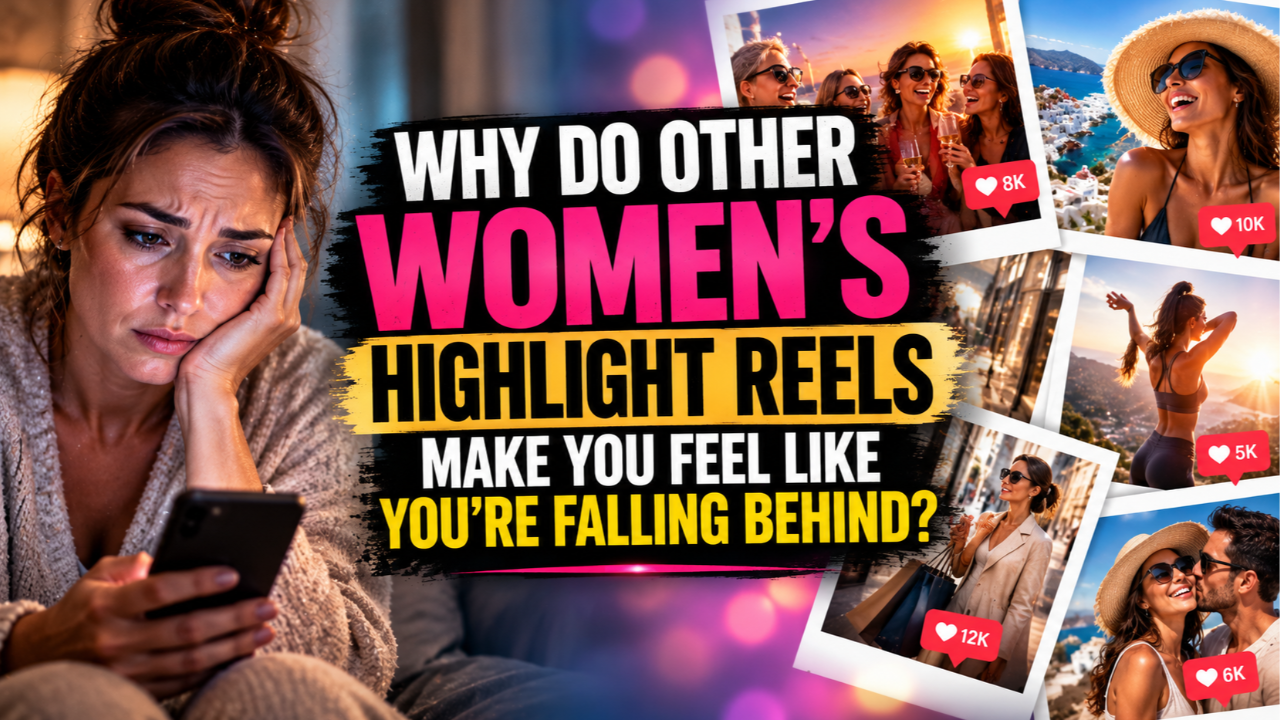
Other women's highlight reels make you feel like you're falling behind because your brain compares your unedited life with their edited best bits, then treats the gap as a threat to your place in the group. Comparison is an ancient survival tool built for small tribes, not for hundreds of polished lives a day. The feeling of being behind is that machinery working as designed. It isn't proof that you're failing.
 It's 11.40pm and you should be asleep. Instead you're propped up on one elbow, thumb moving on autopilot, watching a woman you sat next to in Year 9 collect an industry award in a dress that probably cost more than your car. Then a friend of a friend shows off a kitchen island bigger than your living room, and somebody's toddler eats quinoa and says thank you, while yours called the dog a very rude word at teatime.
And it doesn't switch off when the phone does. It follows you to the school gate in the morning, where one mum has a fresh blow-dry and a calm voice, while you're in yesterday's jumper hissing about a missing shoe. It follows you into the office, where a younger colleague is presenting to the directors and somehow knows what to do with her hands. So, why does a scroll through other people's lives leave you feeling forty minutes late for your own?
Want the full method for backing yourself again instead of measuring yourself against everyone else? Get The Powerfully Confident Woman: Self Confidence For Women on Amazon.
The Story You Tell Yourself About Everyone Else Being Ahead
The story most women believe goes something like this. Everyone else has worked it out. They are more organised, more disciplined, more naturally confident and probably better at mornings. If you were a bit less lazy, a bit more focused and a lot more like them, you'd catch up. So you write another list, buy another planner and promise yourself that this is the week it all comes together.
It's a tidy story with one fatal flaw. You see your own life in full, uncut and badly lit: the row in the car on the way to the party and the morning you cried in the office loo. You see her life after the edit. Nobody posts the argument before the family photo, the forty-six attempts at the casual beach shot or the four o'clock wake-up worrying about the mortgage. You are comparing your behind-the-scenes footage with everyone else's trailer, and the trailer wins every time.
But the school gate and the office are highlight reels too, simply with worse lighting. The mum with the blow-dry may be having the only good hair day of her month. The smooth presenter may have rehearsed in her car for an hour. Everywhere you go, you hold edited footage up against the raw tape in your head, and that contest can only end one way.
What Comparison Is Doing to Your Brain
Here's the machinery. Your brain evolved to keep you alive in small groups of perhaps a hundred and fifty people, where your rank in the group decided whether you ate, found a partner and stayed safe. Keeping an eye on how you measured up against the others was a survival skill. Psychologists call it social comparison, and it runs automatically, the way your heart beats without asking permission. You don't decide to compare. The comparison happens first, and you only notice the feeling it leaves behind.
The trouble is scale. Your ancestors compared themselves with a handful of women in the village, most of whom were having an equally rubbish week. You compare yourself with hundreds of hand-picked best moments before you've brushed your teeth. Your brain cannot tell that the feed is curated. It reads every polished image as a real neighbour pulling ahead, then blends them all into one imaginary woman who is slimmer, richer, calmer and better at everything than you. Nobody could beat her, because she doesn't exist.
When you look up at someone who seems further ahead, your threat system registers a small loss of status. That shows up as the drop in your stomach, the flat mood and the sudden urge to fix something, anything, about yourself. Researchers studying people on Instagram and Facebook have found that this kind of upward comparison on social media is one of the links between scrolling, lower self-esteem and low mood. The app is the stage. Comparison is the play.
The Comparison Loop That Keeps You Scrolling
Every habit runs on a cue, a routine and a reward, and comparing yourself to other women is no exception. The cue is usually a small dip: boredom in a queue, tiredness after the kids are in bed, a vague sense that today didn't go well. The routine is the scroll. The reward is odd, because it rarely feels good. But every so often you find someone doing worse, or a post so absurd it makes you laugh, and that unpredictable little payoff keeps the thumb moving. Your brain's wanting system, driven by dopamine, loves a maybe far more than a certainty.
Over time the loop escalates. You start checking certain people on purpose: the ex-colleague who went freelance, the school friend with the perfect marriage, the sister-in-law who runs marathons. Some of them you don't even like, yet you follow them anyway, which is a strange way to spend an evening. The comparison leaks offline too. You leave the school gate early to avoid the chat. You stay quiet in the meeting because she's already said something clever. You stop sharing your own small wins because they look shabby next to hers.

Each time you shrink, the story gains a little more evidence. You aren't speaking up, so you aren't being noticed, so it does start to look as if you're falling behind. The loop has begun writing its own proof. If the voice narrating all of this sounds harsh, my piece on the inner critic looks at where that commentary comes from.
Why Trying Harder and Deleting the App Both Fail
The first fix most women try is to catch up. Up at five, a new skincare routine, a side business, a sourdough starter. But the gap you're trying to close is measured against a moving target made of other people's best days, so it never closes. The moment you hit one milestone, the feed serves up a woman who hit it three years earlier and did it in heels. Effort aimed at an imaginary finish line burns energy without ever delivering the relief it promised.
The second fix is the dramatic detox. You delete Instagram on a Sunday night, feel wonderfully free on Monday and reinstall it by Thursday, usually while waiting for the kettle. Willpower is a finite resource, and fighting a habit loop with white knuckles tends to fail at the exact moment you're most tired. Worse, the relapse becomes fresh evidence that you're weaker than everyone else, the very story driving the whole thing.
The third fix is the gratitude list and the pep talk. Telling yourself to feel grateful when you're feeling small is a bit like telling a smoke alarm to calm down. It does nothing about why the alarm went off, and it adds a layer of guilt for not feeling grateful enough. None of these fixes touch the machinery. They argue with the output and leave the program running.
Want the full method for building the kind of confidence that doesn't wobble every time you open an app? Pick up The Powerfully Confident Woman: Self Confidence For Women on Amazon and start measuring your life with your own ruler.
There Is No Race, Only a Thousand Trailers
Here's the reframe. Falling behind requires a race, a track and a finish line that everyone agreed on. None of those exist. One woman is building a career, another is raising three children, another is recovering from a divorce and another is quietly working out who she is at fifty. They aren't on your track. You've simply lined them all up in your head and fired a starting pistol that nobody else heard.
I learned a version of this in radio. Early on, I'd listen to award clips of rival presenters and feel sick with envy. Then I sat in on one of their shows and heard the other three hours: the dead air, the fluffed traffic report, the caller who swore live on air. The award clip was ninety seconds out of a whole year of broadcasting. My worst Tuesday had been competing with their best minute.
Envy, handled properly, is useful information. The pang you feel watching another woman's life rarely means you want everything she has. It usually points at one thing. Maybe it's the way she speaks up, the time she seems to keep for herself or the fact that she started the project she talked about. Strip away the rest of her highlight reel and that one signpost is pointing straight at your own life. If envy has become a constant companion rather than an occasional pang, I've written a separate guide to overcoming jealousy.
Your brain will keep comparing. That's its job, and you can't fire it. What you can do is stop treating its verdict as the truth. When the drop in your stomach arrives, it is a reflex reporting that you looked up at an edited image. It isn't a judge announcing that you've failed.
Your First Small Move: Catch It, Name It, Find the Signpost
Start small enough that it feels slightly silly. For one week, every time you feel that drop after looking at another woman's life, online or in person, pause and silently say "comparing." Naming the process creates a sliver of distance between you and the feeling. You move from being inside the comparison to watching it happen, and watching is where change starts.
Then write two short lines in a notebook or on your phone. First, what you saw. Second, the one thing in it you want for yourself. Leave out her house, her husband and her waistline, and look for the signpost underneath. "She posted her pottery class" might become "I want something that's mine." "She led the meeting" might become "I want to say my idea out loud on Thursday." After a week you'll have a short list of real wants, which is far more useful than a long list of reasons you're behind.

Finally, mute rather than unfollow, at least to begin with. Muting the three accounts that leave you feeling worst removes the cue without drama or awkward explanations. At the school gate, try asking the blow-dry mum how she's doing and listening to the answer. People turn back into people up close, usually with the same worries you have. If comparison has slid into persistent low mood, sleepless nights or thoughts of harming yourself, please speak to your GP or a qualified professional alongside any self-help.
The Question Nobody Asks About Falling Behind
Behind whom, exactly? And according to whose timetable? Many women carry a schedule they never consciously chose: married by thirty, house by thirty-two, children, promotion and a body that bounces back. Some of it came from parents, some from school and some from a magazine read at fourteen. When you feel behind, it's worth asking who wrote that timetable and whether you'd sign it today.
Women who feel behind are often brilliant at batting away praise, which keeps the scoreboard permanently rigged against them. I've written about deflecting compliments if that rings a bell. Because if the only wins you count are other people's, and the only failures you count are your own, you'll feel behind forever, whatever you achieve. What would change if you were the only woman on your track?
Want the full method for walking past the school gate, the boardroom and the feed with your head up? Get The Powerfully Confident Woman: Self Confidence For Women on Amazon and find out what confidence feels like when it stops depending on anyone else's highlight reel.
"I used to scroll through other moms' posts every night and go to bed feeling like a failure. Once I realized I was comparing my worst days with their best ones, the spell broke. I muted a few accounts, signed up for the class I'd been putting off for years, and I look forward to school pickup now." (Jennifer M., Tulsa, Oklahoma)
"A younger coworker got the promotion I wanted, and I spent months quietly resenting her. Writing down what I envied showed me I wanted to lead projects, so I asked for one. My manager said yes, and I've finally stopped keeping score." (Denise K., Spokane, Washington)
"At 48 I felt years behind every woman I went to college with. This book helped me see I'd been running a race nobody else had entered. I started the small baking business I'd talked about for a decade, and for the first time in years I feel right on time." (Lorraine B., Asheville, North Carolina)
Frequently Asked Questions About Comparing Yourself to Other Women
Why do I compare myself to other women so much?
Because your brain is built to track where you stand in your group, and other women often feel like the most relevant group to measure yourself against. Comparison runs automatically, so you don't choose it. Social media multiplies the effect by showing you hundreds of edited best moments a day, which your brain treats as real competition. The urge to compare isn't a character flaw. It's an old survival system working in a world it was never designed for.
Is social media comparison bad for your self-esteem?
It can be, depending on how you use it. The hours on the apps seem to matter less than the habit of measuring yourself against what you see there. Women who compare a lot tend to feel worse, while those who scroll without keeping score are less affected. If your mood drops after scrolling, treat that as useful feedback. The NHS has practical guidance on raising low self-esteem that pairs well with muting the accounts that leave you feeling small.
How do I stop feeling like I'm falling behind in life?
Start by questioning the timeline. Feeling behind means you're measuring yourself against a schedule, so ask who wrote it and whether you still agree with it. Then turn envy into information: when someone's life stings, write down the one thing in it you want for yourself and take one small step towards it this week. Muting a few accounts helps too. Over time you'll measure progress against your own last month, which is the only fair comparison there is.
About the Author
 Craig Beck spent years as a UK broadcaster, which taught him that every confident voice on air comes with plenty of wobbles off air. He is a certified NLP Master Practitioner, a lifelong student of persuasion and human behaviour, and the author of more than 100 books covering confidence, anxiety, wealth and quitting alcohol. His work skips the cheerleading and shows readers the mental software running their habits. Find out more on his about page, read the story behind The Powerfully Confident Woman, or explore one to one coaching.
Last updated 21 October 2026.