Adolf Hitler And The Psychology Of Evil: Inside The Mind | Craig Beck
May 02, 2026Adolf Hitler And The Psychology Of Evil
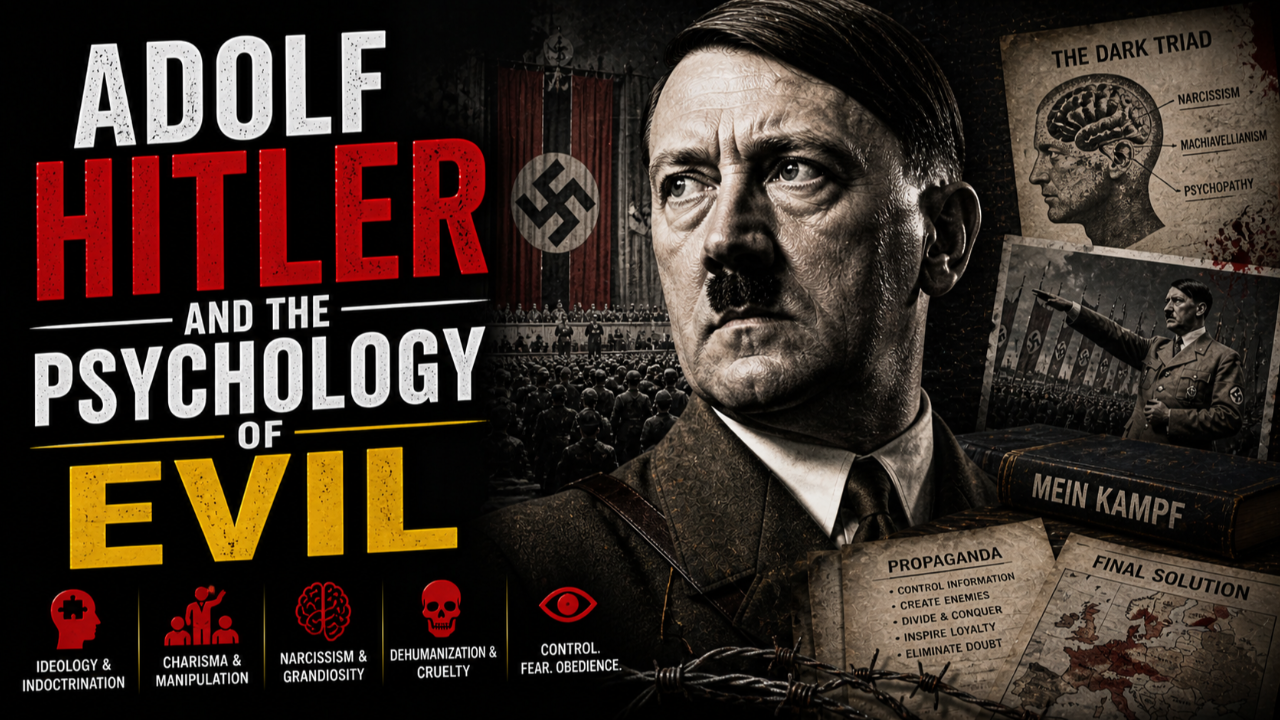
Adolf Hitler and the psychology of evil sit far closer together than most history books admit. He was no comic book lunatic. He was a wounded narcissist who turned personal humiliation into political theatre, harnessed mass propaganda with chilling precision, and weaponised collective grievance against Germany's most vulnerable citizens. His evil was systemic, never solitary. He needed millions of compliant minds to make the machine run. The same psychological levers he pulled in 1933 remain pullable today, by anyone with a microphone, a target, and a frightened audience hungry for someone to blame.
Adolf Hitler And The Psychology Of Evil: The Real Mechanic
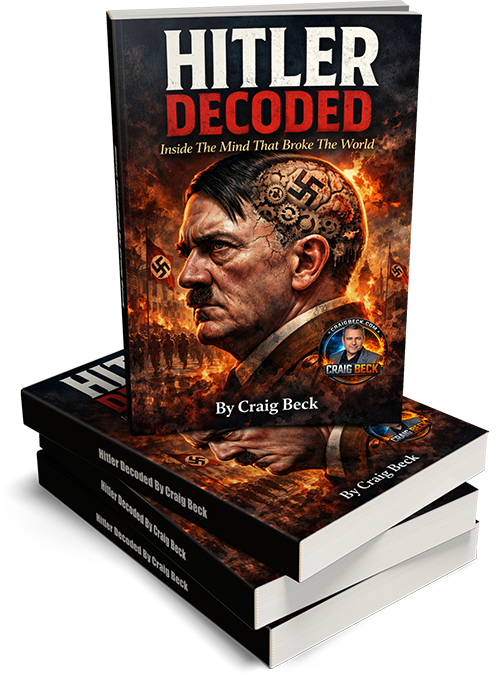 Evil at this scale never rises because one disturbed man shouts loudly enough. It rises because the disturbed man becomes useful to the fears, frustrations, and fantasies of millions. Hitler offered Germany an explanation for its pain that was simple, emotional, and intoxicating. The Treaty of Versailles in 1919 had stripped the country of pride, territory, and economic stability. Hyperinflation in 1923 wiped out savings overnight. By 1932 over thirty percent of the workforce was unemployed. People wanted relief, but underneath the relief they craved meaning, and meaning is far easier to manufacture than recovery.
He supplied both. He told Germans they had not been defeated, flawed, or responsible. They had been betrayed. Stabbed in the back. Destined for greatness if only the parasites, traitors, and outsiders were swept out of the body politic. It was a psychological sugar rush served to a wounded nation, and the bill arrived in cattle trucks twelve years later. Humans love that sort of nonsense whenever the mood is dark enough. We always have. We always will, until somebody calmly names the trick out loud.
Adolf Hitler and the psychology of evil belong together because he never invented anything new. He simply weaponised the oldest social shortcut we own. Find the people in pain. Hand them a villain. Promise them belonging in exchange for obedience. The recipe is older than the alphabet. He merely modernised the kitchen, added microphones, and let the drumbeats do the rest.
The Damaged Boy Behind The Dictator
If you are hunting for one tidy childhood event that built him, you will leave disappointed. The mind is never a vending machine, and the road from Braunau am Inn to Berlin runs through a hundred turns rather than one. Yet patterns matter, and his pattern is loud.
His father, Alois, was authoritarian, distant, and prone to physical discipline that crossed into cruelty. His mother, Klara, was doting, deferential, and over-attached. That combination breeds a volatile inner split. On one side, humiliation, fear, and suppressed weakness from the father. On the other, fantasies of specialness and rescue stitched in by the mother. Add academic failure, two rejections from the Vienna Academy of Fine Arts in 1907 and 1908, and a long stretch sleeping rough in men's hostels, and you get a young man who cannot tolerate the idea of being ordinary.
The First World War handed him a borrowed identity. He found structure, comradeship, ritual, and permission to belong to something larger than himself. The German defeat in 1918 ripped that identity away while he lay temporarily blinded by mustard gas in a military hospital. The trauma was not the gas. The trauma was waking up to a country that had collapsed in front of him while he was still convalescing. Personal humiliation fused with national humiliation in a single moment, and he never released the seam where the two had welded.
So, he did more than hate. He needed hate. It organised him. It gave the chaos inside a direction.
Pathological Narcissism With An Army Behind It
Most people use the word narcissist as if it means vain and mildly annoying. Hitler embodied a far darker variant. His clinical fingerprint shows grandiosity, hypersensitivity to shame, black and white thinking, paranoia, and an inability to perceive other human beings as fully real unless they served his internal drama. Other people stopped being people. They became mirrors, tools, or obstacles, and obstacles can always be removed.
He cast himself as a messianic figure, the chosen redeemer of a wounded nation. Once a man believes he is the instrument of history, ordinary morality becomes an inconvenience. Compassion becomes weakness. Doubt becomes betrayal. Criticism becomes treason. Atrocity becomes duty. That is the ladder he climbed, one rung of self-mythology at a time, while clapping crowds supplied the soundtrack.
Arguing facts with men like Hitler rarely works because facts threaten the fantasy, and the fantasy is not decoration. It is life support. The same dynamic appears in milder doses across modern political life, which is part of the reason his case still matters. Craig's Putin profile traces a recognisably similar pattern of grievance, grandiosity, and fused personal pride with national mission. Different country, different decade, the same psychological skeleton wearing fresh clothes.
The Hypnotic Theatre Of Mass Persuasion
Hitler was charismatic in the cold, technical sense of the word. He understood mass persuasion at a gut level long before academic researchers had names for the techniques he was deploying. He grasped that repetition outperforms reason, that emotion outruns evidence, and that frightened people do not need a detailed policy plan. They need certainty, rhythm, identity, and a believable promise that their suffering is meaningful rather than random.
Joseph Goebbels engineered the broadcast machinery, but the underlying script was Hitler's. Give people a slogan, a scapegoat, and a permission slip to feel superior. Many will follow you straight into hell while congratulating themselves on their moral clarity. The Nuremberg rallies were never debates. They were emotional conditioning sessions dressed in marching boots, complete with torch light, drumbeats, and choreographed crowd response. Court records preserved by the Yale Law School Avalon Project document the mechanics of those rallies in chilling detail, drawn straight from the Nuremberg trial proceedings.
He mirrored the pain of his audience first. He amplified their grievance second. He offered release through unity and aggression third. That is the rule of three at its most lethal. Once people felt seen, threatened, and handed a script in quick succession, the system did the rest. Human beings are no obedient robots, but our species is remarkably suggestible when fear, identity, and resentment are skilfully stitched together by a confident voice.
How Ordinary Germans Became Quiet Accomplices
This is the section most readers prefer to skim because it bruises the ego. Polite societies enjoy imagining that atrocity is carried out by obvious monsters. Snarling officers, theatrical cruelty, jackboots in the street. Far easier that way. The truth is messier, smaller, and quieter.
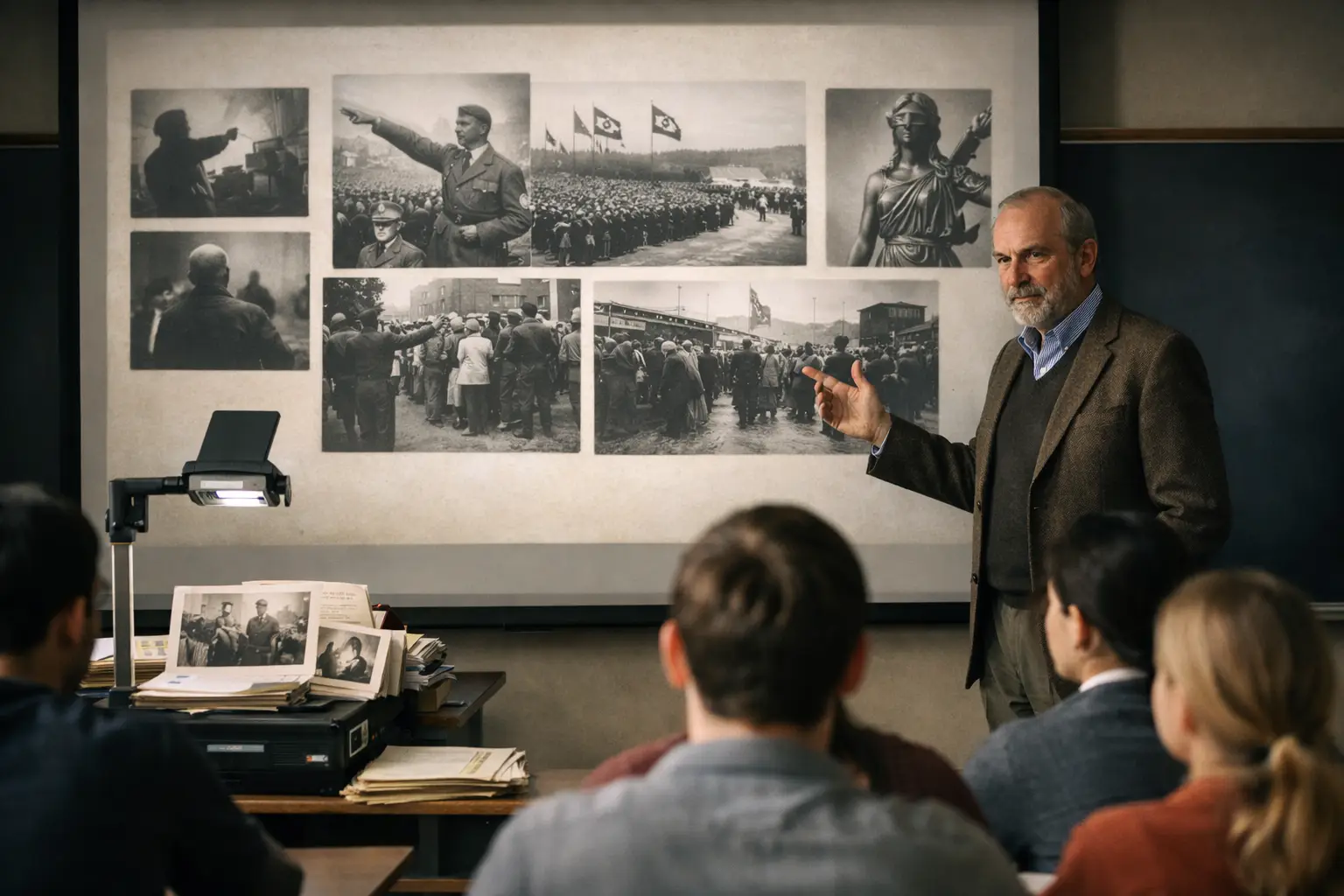
The Nazi regime relied on bureaucrats, professionals, neighbours, police officers, teachers, doctors, train drivers, accountants, and citizens who adjusted themselves one compromise at a time. Some were ideological fanatics. Some were cowards. Some were ambitious careerists. Many were merely adaptable in the bleakest sense of the word. The United States Holocaust Memorial Museum encyclopedia documents how thoroughly the regime depended on millions of small, daily acts of compliance to function at all.
That is how moral collapse usually unfolds. The language changes first. Then the target is dehumanised. Then the cruelty is rationalised as necessary, temporary, or deserved. By the time the bodies pile up, the conscience has already been trained to look elsewhere. The most dangerous feature in human psychology is rarely rage. More often it is compliance wrapped in self justification, polished daily until it shines like virtue. Craig's profile of Jimmy Savile shows the same dynamic operating on a smaller scale inside post war British institutions, where polite silence enabled decades of abuse.
The Madman Myth That Lets History Repeat
Calling Hitler insane feels satisfying. It is also a dodge. Yes, he carried delusional, paranoid, and probably amphetamine fuelled cognitive distortions in his final years. Yes, his worldview was detached from reality and saturated with conspiracy. He was also strategic, calculating, and acutely sensitive to public mood, sometimes to a degree his generals found infuriating. The man who lost a world war made tactical decisions that built the largest land empire in modern European history before he made the catastrophic ones that lost it.
Labelling him simply mad lets the rest of us off the hook. It turns history into an accident produced by one broken brain. He was a psychological predator who found a culture primed for manipulation, institutions too fragile to resist him, and enough citizens willing to trade conscience for belonging. That is a colder explanation than the cartoon version, and a far more useful one for any society wanting to avoid an action replay.
If evil only wears the face of madness, you will miss it the next time it puts on a tailored suit, talks calmly about national renewal, and tells frightened people exactly what they want to hear. Craig's survey of dark psychology titles covers the persuasion toolkit demagogues borrow from each other generation after generation, with surprisingly little innovation along the way.
What Adolf Hitler Still Teaches Free Societies
The lesson is bigger than one Austrian corporal who built an empire and a graveyard. The lesson is that unresolved humiliation, collective grievance, and identity based propaganda can turn a society into an accomplice faster than most citizens believe possible. The conditions are not exotic. They live in any country with anxious voters, weak institutions, and a confident liar holding a microphone.
Watch for leaders who make complexity vanish. Watch for anyone who needs enemies more than solutions. Watch for moral language used to excuse cruelty. Watch your own mind too, because every authoritarian project begins inside private little seductions. The hunger to belong. The thrill of certainty. The relief of blaming someone else. None of those impulses are evil on their own. They become evil when a skilled operator hooks them together and aims them at a target.
If you read serious true crime profiles for more than war footage and old newsreels, the Hitler case is one of the few studies that doubles as a defensive manual. Once you spot the pattern, the same trick stops working on you. The next time a charismatic voice promises you a clean villain and a glorious future, you will feel a small, useful chill that you did not feel before. Trust that chill. It is older than democracy and considerably more reliable.
What readers are saying. "I have read more books on Hitler than I would like to admit, and most of them recycle the same battlefield narrative. Craig Beck does something different. He explains the wiring rather than the chronology, and the result is genuinely unnerving. Five stars and a long, thoughtful walk afterwards." Gregory Hammond, Charleston, South Carolina.
"Beck writes the way an angry, intelligent friend talks after one too many drinks. Funny, blunt, and occasionally cold to the bone. The chapters on grievance and mass persuasion alone are worth the price of admission. I have already given a copy to my father in law." Stephanie Grayson, Madison, Wisconsin.
"As a retired political science instructor, I came in sceptical. I left convinced. Beck synthesises personality theory, persuasion, and historical evidence in a way that rarely happens at a popular level. This is the rare book on a tyrant that teaches you something useful about your own neighbourhood." Anthony Vasquez, Albuquerque, New Mexico.
About The Author
 Craig Beck is widely regarded as the world's leading authority on persuasion and human behaviour. A certified NLP Master Practitioner, former UK broadcaster, and bestselling author of more than one hundred titles, he has spent over twenty years dismantling the question of why human beings say yes when they should be saying no. More than a million readers across the globe have leaned on his work to understand the hidden mechanics of influence, decision making, and motivation. He does not lecture from theory. He shows you how the wiring of human behaviour really fires once the polite social mask drops. His ongoing Decoded series applies the same forensic lens to the most disturbing minds in modern history.
Last updated: 1 May 2026.
Frequently Asked Questions About Adolf Hitler And The Psychology Of Evil
Why did so many ordinary Germans support Adolf Hitler?
Most ordinary Germans did not support him out of hatred at the start. They supported him out of pain. The country had been crushed by the Treaty of Versailles, hyperinflation in 1923, and mass unemployment by 1932. He offered them simple villains, restored pride, and a sense of purpose. Add fear of communism, weak political alternatives, and a propaganda machine that drowned dissent, and the slide toward consent looks far less mysterious. People rarely follow tyrants because they admire tyranny. They follow because tyranny is sold as rescue.
Was Adolf Hitler clinically insane?
Probably no, certainly not in any legal sense, although he carried serious personality pathology, paranoid delusions in his final years, and likely amphetamine related cognitive damage. Modern forensic readings often describe him as a malignant narcissist with strong paranoid features rather than a textbook psychotic. He was strategic, manipulative, and deeply attuned to public mood. Calling him simply mad is a comforting dodge that lets society avoid the harder question of how rational people allowed his worldview to become public policy.
What is the most important lesson from Adolf Hitler's psychology?
The clearest lesson is that mass evil rarely begins with violence. It begins with language, grievance, and the seductive offer of an easy enemy. He weaponised humiliation, fused personal damage with national resentment, and used emotional manipulation rather than argument. Free societies stay free when their citizens recognise the pattern early. That means refusing simple villains, distrusting moral certainty, and treating any leader who promises pain free greatness as a possible threat to civilisation rather than a saviour of it.