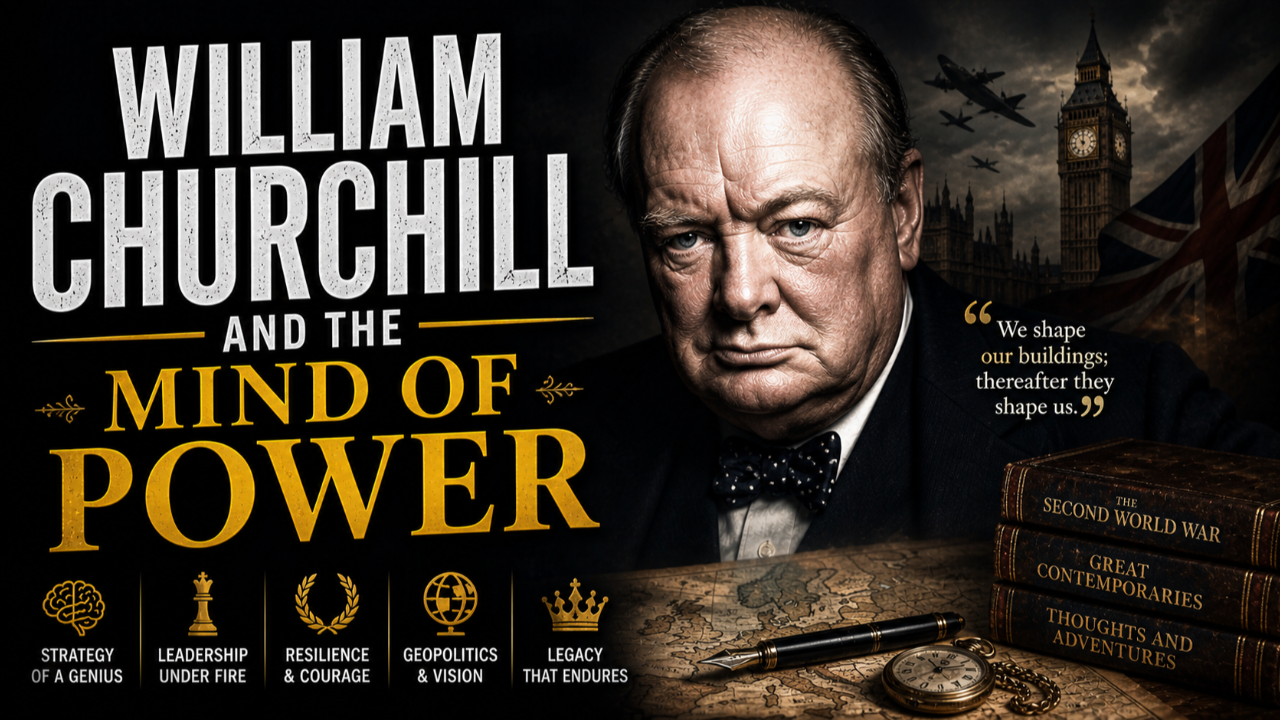
Winston Churchill: Inside the Mind of Power | Craig Beck Decoded
May 02, 2026Most people picture Winston Churchill as a marble bust clutching a cigar, an old man muttering about beaches and never surrendering. That cartoon does him no favours and teaches you nothing useful. Winston Churchill and the mind of power is the study of how one man turned childhood neglect, public humiliation and the slow collapse of an empire into history's most recognisable voice of defiance. He was not born certain. He built certainty through disciplined self-construction, weaponised language and a refusal to let circumstance write his identity for him. Decoding him is decoding the architecture of influence itself.
 Walk into any airport bookshop and you will find dozens of leadership books promising to make you bulletproof. Most read like watered porridge dressed up in a hardback. Churchill is the antidote. Volatile, theatrical, stubborn, often staggeringly wrong, and yet absolutely required the moment the lights began to go out across Europe. Perfect men teach you nothing. Complicated men show you the wiring underneath performance, persuasion and survival. So, this is not a marble polishing exercise. It is a forensic look at a man who could project unshakeable certainty into national chaos and convince an exhausted country that it could endure what looked impossible.
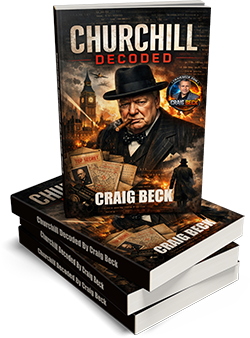
Want the full psychological autopsy of the man who refused to flinch when refusal looked insane? Grab Churchill Decoded: The Psychology of Stubbornness, Vision, and Survival on Amazon. It strips the legend down to the levers.
Who Winston Churchill Really Was Underneath the Statue
There are two Churchills in popular memory. The first is a snarling bulldog standing on a London rooftop while bombs fall, daring history to come and have a go. The second is the cigar-chewing wit at a Mayfair dinner party, dispatching political enemies with a single sentence. Both exist. Neither tells you a single useful thing about the inner machinery.
The man underneath was a peculiar blend of aristocratic privilege and emotional starvation. Born in 1874 at Blenheim Palace, raised by nannies more than parents, packed off to schools that prized cruelty as character building. He was small, asthmatic, awkward, and eternally hungry for the approval of a father who barely looked at him. By the time he reached adulthood, he had already learned the lesson that would shape every move he ever made. If you want to be loved, you must first become unmissable. He never let go of that lesson, and it built him.
The Childhood That Hammered the Iron
Lord Randolph Churchill was a brilliant, abrasive, mentally deteriorating politician who treated his son with a mixture of disappointment and indifference. His American mother, Jennie, was glamorous, charismatic, and almost permanently absent. The young Winston wrote her dozens of letters from boarding school begging for visits she rarely made. Most psychologists will tell you that a child raised in this kind of emotional vacuum tends to fold one of two ways. He either turns inward and disappears, or he swings the other direction and decides to make the world look at him whether it wants to or not.
Churchill chose the second route, and he chose it with violence. By 21 he was charging into battle in Cuba, India, and Sudan, getting shot at on three continents in pursuit of a story that would force his name onto the front pages of British newspapers. Every cavalry charge was, on some level, a letter to a dead father. Look at me. Look at me now.
This is a pattern you will see again and again in high performers. The unmet emotional need of childhood becomes the engine of adulthood. Steve Jobs had it. Elon Musk shows traces of it. Decode any public figure who refuses to be ignored and you will usually find a small child in the background still trying to be seen. Churchill simply gave that child a global stage and a war to win.
Language as a Loaded Weapon
Strip the legend down and Churchill's true superpower was not strategy. It was sentences. He understood, long before any neuroscientist confirmed it, that human beings do not respond to facts. They respond to the emotional shape of facts. Frame the meaning, and you control the response. Hand people raw information and you have lost the room before you opened your mouth.
His speeches did three things at once. They named the threat without sweetening it. They reframed terror as honour. And they handed listeners an identity strong enough to carry the weight. He never told the British public that everything would be fine. He told them they were the last decent thing standing between civilisation and barbarism. That is a much harder drug to refuse than reassurance.
Compare that with most modern leaders who try to soothe an audience into compliance. Churchill went the opposite way. He raised the stakes deliberately. He made survival feel like a moral promotion. This kind of persuasion is closer to hypnosis than public speaking. It bypasses the analytical brain and embeds itself in the limbic system, where decisions are quietly made before the conscious mind realises a vote is happening.
Modern self-help often nags you to police your self-talk. Fine, as far as it goes. Churchill points to the deeper rule. The vocabulary you use about yourself becomes the architecture of your courage. Vague language produces vague behaviour. Flabby words produce flabby decisions. Sharpen the language and the nervous system has something stronger to wrap itself around.
Why rhetoric slips past logic
People love to insist they are rational beings. They are not. Logic is a press secretary, not a decision maker. Emotion votes first, then logic walks out and explains the vote to the cameras. Churchill seems to have grasped this in his bones. He used rhythm, contrast, and image because those weapons skip the front door of the mind and let themselves in through the back. Repetition creates familiarity. Familiarity creates trust. Trust creates compliance. That sequence has not changed in eighty years, and the founders of every credible communications firm on the planet still earn their fees from it, whether they cite Churchill or not.
The Dark Triad Hiding Inside Greatness
Here is where most biographies lose their nerve. To tell the truth about Churchill, you must admit that some of his strengths sit uncomfortably close to traits we usually file under much darker portraits. Narcissism. A flair for the dramatic. A willingness to bend facts to win a room. An almost theatrical lack of empathy when crossed.
This is not me dragging him down to the level of the man he opposed. The two could not be further apart in moral architecture. But the Dark Triad does not show up only in killers and dictators. It appears, in milder doses, in many of the people who reshape the world. The deciding variable is the cause they serve and the limits they accept on themselves.
Churchill carried a wild ego, a hunger for centre stage, and a strategic mind that did not always wait for the morality committee to catch up. What he also carried, and what saved him, was an unshakeable belief in liberty as a non-negotiable. The ego served the cause. When ego serves the self alone, you get tyrants. When ego serves a principle bigger than the self, you sometimes get the man who kept Britain in the war when every rational analysis said sue for peace.
That is the uncomfortable maths of greatness. The traits we cluck at in everyday life are often the same traits that show up in the people who refuse to bend when bending is the sensible option.
Resilience That Looked Like Hunger
Resilience has been butchered by motivational posters into something that sounds like grim teeth-gritting. Churchill's version was wilder than that. He did not endure pressure. He fed on it. The bigger the crisis, the more focused he became. Calm seas left him restless and depressive. He famously called his depression the black dog, and you can see in his letters that peace bored him almost as much as failure shamed him.
He had collapses. The Gallipoli disaster of 1915 nearly broke him. He spent the 1930s in the political wilderness, ignored, mocked, and treated as a relic clinging to outdated certainties. Most people would have packed it in, taken the country pile, written the memoir. He kept writing, kept warning about Hitler, kept building the version of himself that 1940 would eventually require, even when nobody had ordered it.
That is the lesson worth stealing. Resilience is not the absence of collapse. It is the ability to reassemble around a mission faster than the world expects. If you see yourself as a victim of events, every setback fractures you. If you see yourself as a person built for difficult moments, the same setbacks become rehearsal. Same pressure, different internal verdict.
The deeper question is not, how do I feel today. It is, who am I when conditions are foul. The first makes you a hostage to weather. The second makes you a fortress.
If this is the kind of psychological excavation you came for, the book goes much deeper into the stubbornness, vision and survival instincts that made Churchill possible. Worth a few hours of your evening if you are tired of leadership books that sound like LinkedIn karaoke.
How Churchill Hunted Doubt and Buried Defeat
By May 1940, Britain had no business surviving. The army was being driven into the sea at Dunkirk. France was folding. The United States was watching from a polite distance. Half the British cabinet wanted to negotiate with Hitler through Mussolini, and on paper they were correct. The numbers said capitulate. The geography said capitulate. The cold rational read of the situation said capitulate.
Churchill walked into the war cabinet on the 28th of May and refused. Not with a slide deck. Not with a careful balance sheet. He refused with story. He told them that nations which went down fighting rose again, and nations which surrendered tamely vanished from history. He hunted the doubt in that room and killed it sentence by sentence.
This is influence at its most ferocious level. He did not win the argument with new information. He won it by replacing the dominant emotional frame in the room. Fear became dishonour. Survival became contempt. Within hours, men who had been wobbling were ready to bet the country on a refusal that the rest of the world considered insane.
You will not find that skill in a TED talk. It is forged through decades of writing, speaking, failing, being mocked, and continuing anyway. Churchill had been rehearsing for that single meeting his entire adult life. When the moment came, the instrument was tuned and the man walking out of Number 10 had spent forty years preparing to refuse.
The Cost of Being the Voice in the Storm
There is no honest portrait of him without the costs. The same boldness that saved 1940 produced Gallipoli, the catastrophic British response to the Bengal famine of 1943, and a streak of imperial certainty that has aged badly. The same fierce loyalty to Britain blinded him to the dignity of those Britain ruled. The same theatrical confidence that thrilled a nation in crisis grated against colleagues in calm.
The trade-off is the real lesson, and it is the one most leadership books refuse to print. Strong personalities come bundled. You do not get the bulldog without the bite. You do not get the conviction without the rigidity. You do not get the vision without the tunnel attached.
Trying to keep his strengths and surgically remove his weaknesses is a fantasy. The same engine produces both. The honest goal is awareness. Know which version of yourself the moment demands, and know which excesses you must hold on a leash. Boldness without self-awareness is expensive damage. Study other powerful men in the same league and you will see what happens when those leashes go slack.
What Winston Churchill Teaches You About Modern Power
Influence today is feeble because it is desperate to be liked. That single misalignment ruins it. Churchill was not in the liking business. He was in the believing business. Those two outcomes are produced by completely different inputs.
If your priority is approval, your message softens, hedges, and over-qualifies itself into background noise. If your priority is belief, you speak with more edge, more clarity, and more consequence. People do not follow comfort. They follow conviction that has receipts.
His authority was not a clever bit of branding. It was the residue of decades of repeated self-construction under pressure. He had paid the bill in failures, sackings and political exile long before 1940. By the time the country needed someone who looked unshakeable, the man had been quietly making himself unshakeable for forty years, mostly in private, mostly while being laughed at.
You do not need to be born with charisma. You must build a mind that can hold pressure, organise language, and act before certainty arrives. Stop waiting to feel ready. Readiness is a side effect of doing, not a permission slip you receive in the post. A deeper dive into his decoded psychology will show you the courage came after the action, not before it.
The Question Nobody Asks About Churchill
Most analysis of him asks how he won. The far more useful question is why he refused to lose, even when losing was the polite, sensible, mathematically defensible option on the table. The answer sits in his identity, not his strategy. According to the International Churchill Society archives, his private letters from his political wilderness years are full of unwavering self-reference, even while the country had quietly written him off.
He had decided, somewhere in childhood, that he was a person of consequence. Every defeat after that simply became evidence the world had not yet caught up with the file. That is a subtle but enormous psychological shift. Most of us treat failure as proof we were wrong about ourselves. He treated failure as proof the timing was wrong. Same event, opposite story, completely different downstream behaviour.
This is the operating system of every person who eventually breaks through after years of being dismissed. They keep their identity intact while the world rearranges itself around them. Their refusal to update the self-image is the very thing that drags reality into line. You can see it in the photographs at the Imperial War Museum, where the same set of the jaw appears in his thirties, fifties, and seventies. The man did not change. The world did.
So, if Churchill leaves you with one usable challenge, let it be that. Speak to yourself with more command. Carry yourself with more intent. Stop treating pressure as proof you are not ready. Pressure is very often the moment your real identity is asking to be born.
Ready to go further than this overview? Churchill Decoded: The Psychology of Stubbornness, Vision, and Survival takes a scalpel to every layer of the man, the era, and the mind that refused to bend. Available on Amazon now.
What Readers Are Saying
"Beck does what no other Churchill book bothers to do. He stops describing the man and starts diagnosing him. I read it in one sitting." Marcus Whitfield, Denver, Colorado.
"I have read about thirty Churchill biographies. This is the first one that bothered to explain why he was who he was, instead of just listing what he did. Useful and unflinching." Diane Halloran, Boston, Massachusetts.
"I bought this expecting another wartime fan letter. I got a brutal piece of practical psychology I keep quoting back to myself. Worth every cent." Patrick Reyes, Austin, Texas.
Frequently Asked Questions
Was Winston Churchill clinically depressed?
Almost certainly yes. He referred to his low periods as the black dog, a phrase that survives in clinical psychology to this day. By modern criteria he likely met the threshold for recurrent major depression, possibly with hypomanic features given his bursts of extraordinary energy and creative output. What is striking is that he treated his depression as a known co-tenant rather than a diagnosis to hide. He kept working through it. That coexistence between vulnerability and ferocious productivity is part of what makes him such a useful psychological case study even now.
What made Winston Churchill such an effective public speaker?
Three things, in order of importance. He wrote his own material obsessively, often dictating sentences over and over until the rhythm felt right in the mouth. He paid more attention to emotional architecture than logical content. And he understood that during a crisis a country does not need a careful explanation. It needs a coherent feeling to organise around. His speeches gave Britain a usable identity in 1940 when the facts on the ground offered nothing but humiliation and retreat.
What is the dark side of Winston Churchill that admirers tend to skip?
His record on India, the Bengal famine of 1943, and the Tonypandy mining disputes shows a man whose imperial certainty caused real and lasting harm. He held views about race and empire that are indefensible today, and were uncomfortable even to many in his own time. Decoding him properly means holding both truths in your head at once. The same mind that saved Britain in 1940 caused suffering elsewhere. Greatness and damage often share a postcode, and refusing to see that is how hero worship turns into stupidity.
About the Author
 Craig Beck is widely recognised as the world's foremost authority on persuasion and human behaviour. A certified NLP Master Practitioner, former broadcaster, and bestselling author of more than one hundred books, he has spent two decades reverse engineering why people say yes. More than a million readers across the globe have used his work to understand the hidden mechanics of influence, decision making, and motivation. He does not deal in theory. He shows you how the wiring of humanity quietly runs every conversation you walk into.
Last updated: 2 May 2026