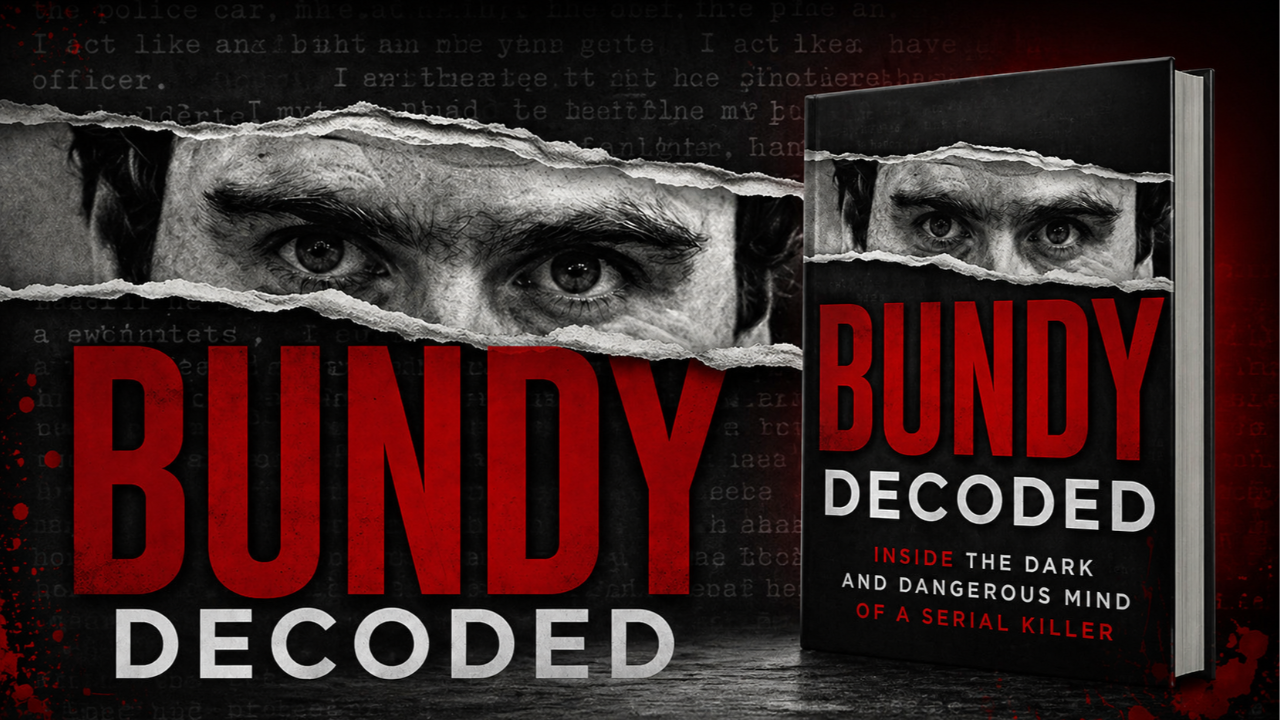
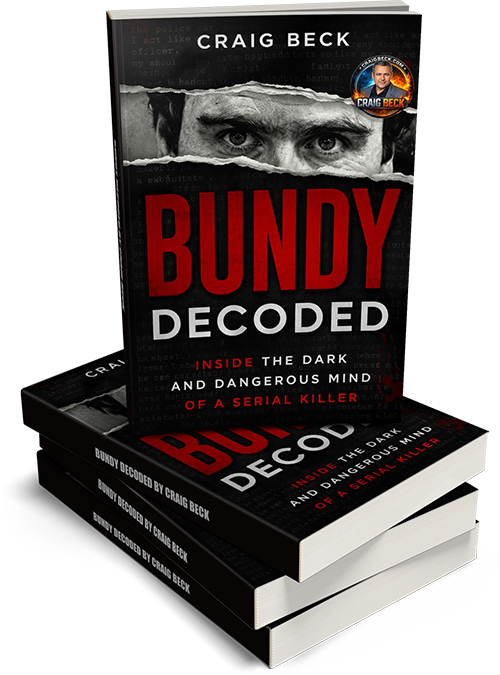
Ted Bundy Decoded: Inside The Dark and Dangerous Mind of a Serial Killer
Apr 26, 2026The Smile That Killed Thirty Women
 If you walked past Ted Bundy on a busy street in 1974, you would have noticed him for all the wrong reasons. The strong jaw, the easy grin, the kind of confidence that made other men adjust their posture and women hold eye contact a beat longer than they meant to. You might have thought him a young lawyer, a politician on the rise, a future husband for somebody's lucky daughter. You would not have thought him a killer. That was the entire point. That was the whole bloody trick.
The Ted Bundy Story
We have been told the story of Ted Bundy so many times that it has lost its teeth. Documentaries trot him out every few years like a Halloween decoration, the same grainy courtroom footage, the same sound bites about charisma and evil and the all-American boy who turned out to be something rotten underneath. You have probably watched one of them with a takeaway on your lap.
You have probably heard a friend say something like, "I cannot believe he did all that," before changing the subject because the subject is, frankly, exhausting. Bundy has become a brand. The man behind the brand has gone missing.
Bundy Decoded Like Never Before
That is the problem I wanted to fix when I sat down to write Bundy Decoded. Not another biography. Not another lurid roll call of victims and crime scenes. Something more useful and a great deal more uncomfortable. A psychological deconstruction. A look at the wiring of the man, the loose connections that produced the charm, the cold logic that produced the violence, and the silence inside him where a conscience was supposed to be. If you have ever wondered how a person can save lives at a suicide hotline on Tuesday and end one in a sorority house on Saturday, that is the question this book sets out to answer.
A Normal Monster
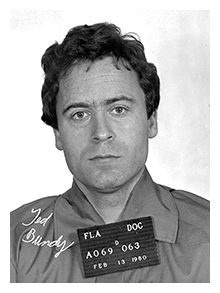 Here is the part that should make you uneasy before you have turned a single page. Ted Bundy did not pounce on his victims from the shadows. He asked them for help. He stood in plain daylight with a fake cast on his arm and politely requested a hand carrying his books to his car. He was handsome, well-spoken, vaguely apologetic about the imposition. The young women who said yes to him were not careless. They were not stupid. They were good people doing the thing that good people are taught to do, which is to extend kindness to a stranger who appears to need it.
Bundy had reverse-engineered that instinct. He had figured out, long before any persuasion expert wrote a textbook on the subject, that human beings run on a small set of predictable triggers. Reciprocity. Authority. Social proof. Drop the right cue at the right moment and the body will obey before the brain catches up.
The Truth About Bundy
That is the bit that nobody wants to talk about, because it implicates the rest of us. We like to imagine that the victims of serial killers must have done something wrong, ignored some obvious red flag, walked down the dark alley when their mother told them not to. It is a comforting story. It puts a wall between them and us. The truth is that Bundy's victims were taken because their decency made them legible to him. He read their politeness like a code, and he wrote himself into the gap.
If you have ever held a door open for somebody you had not seen coming, you have done what Lynda Healy did. You have done what Georgann Hawkins did. You have done what the women at Lake Sammamish did on a sunny Sunday in July. The line between you and them is not as thick as the documentaries pretend.
Human Behavior Expert
I have spent most of my working life studying human behavior, persuasion, and the strange machinery that drives us to make the choices we make. I have written about addiction, about influence, about the lies we tell ourselves at three in the morning when the wine is gone and the phone is heavy in the hand. Bundy is the darkest case study I have ever worked on, and he is also the most instructive. He shows you, with unbearable clarity, what happens when a person learns the operating manual for the human heart and decides to use it as a weapon.
There is a lesson in that for all of us, and the lesson is not "be afraid of strangers." The lesson is much weirder than that. It is "the things that make you a good person are the same things that make you a target, and the only protection you have is the small voice in your head that you have probably been trained to ignore."
Not A Normal Crime Book
Bundy Decoded is not built like a true crime book. It is built like a profile, a character study, a long honest conversation about a man who pretended to be ordinary and was extraordinary only in the scale of his deceit. There is a chapter on the boy nobody knew, the strange childhood lie about his parentage that taught him before he could ride a bike that the world runs on misdirection. There is a chapter on the performance of a lifetime, the courtroom carnival in which he chose fame over survival because his vanity had grown louder than his instinct to live.
There is a chapter on the words he chose, the death row confessions that lasted one hundred and fifty hours and revealed both more and less than the people listening had hoped. There is a chapter called What Remained, which deals with the legacy, the ashes scattered over the mountains, the crowd outside the prison cheering with frying pans and fireworks while a state-sanctioned execution took place inside.
The Psychology Of A Serial Killer
And there is the chapter that gives the book its name. The decoding itself. The psychology stripped down to its working parts. I lean on three thinkers, because their work cuts straight to the bone of who Bundy was. Robert Cialdini, the godfather of compliance research, whose six principles of influence read like a blueprint for how Bundy got his victims into a car. Joe Navarro, the former FBI man who has spent his career teaching the rest of us why we are so terrible at spotting a liar, and why the most dangerous deceivers do not have tells because their bodies believe the lie as completely as their mouths speak it.
Learning The Lessons
When you put those three lenses over the Bundy story, something shifts. He stops being a mystery and starts being a mechanism. You can see the parts moving. You can see how the parts were assembled. And, more importantly, you can see how the same parts exist in the world right now, in different bodies, in different cities, wearing different faces. Bundy died in 1989. The conditions that produced him are still operational. They sit in offices, walk dogs, send messages on dating apps, smile at you in queues. Most of them, the overwhelming majority, will live and die without harming a soul. A small number will not. The book is about how to tell the difference, and about why telling the difference is so much harder than the films pretend.
He Got The Chair
I should be honest about the tone. This is not a polite book. There are sections that are graphic, because the truth of what Bundy did was graphic, and softening it would be a kind of lie. There are moments of dark humor, because if you cannot find anything to laugh at across four hundred pages of darkness, the darkness will start to swallow you. And there are passages that are designed to make you uncomfortable in a useful way, the way a hand on a hot kettle is uncomfortable in a useful way.
Discomfort is information. It tells you something is wrong. The whole point of the book is to give you back access to your own discomfort, because Bundy's victims, almost without exception, felt that discomfort and overrode it out of sheer good manners.
Ted Bundy The Audiobook
 If you prefer to listen rather than read, the audiobook has been produced with the same care as the manuscript. There is a strange pleasure in hearing this kind of material delivered out loud, the pauses landing in the right places, the cadence shifting when a chapter slips from biography into something nastier. Audiobooks suit true crime in a way that feels almost confessional. You are alone in the car or the kitchen, the voice is in your ear, the story unfolds at the pace a real conversation would unfold. By the time you reach the courtroom chapters, you will feel as though you have been sitting on the bench beside the lawyers, listening to a man perform himself into the electric chair.
Understanding Serial Killers
I am not going to insult you with promises that this book will change your life. Books that promise to change your life almost never do. What this book might do, if you let it, is change the way you read other people. The way you weigh the polite stranger against the gut feeling. The way you grant trust, and the way you withhold it. Those small recalibrations are worth more than any grand transformation, because they happen in the moments that matter, the ones where the choice you make in three seconds shapes the next three years of your life. Bundy's victims had three seconds. Most of them used the seconds to be helpful. I would like the readers of this book to use the seconds to be careful instead.
Understand Bundy, Understand Risk
There is one last thing worth saying before you decide whether to pick up a copy. The reason Bundy still matters, the reason we are still talking about him almost forty years after his death, is not because he was unique. It is because he was a prototype. A clean, visible example of a pattern that keeps repeating, in different costumes, in different decades. Every generation produces its own version. Every news cycle dredges one up.
The names change, the methods change, the technology changes. The architecture underneath does not. If you understand Bundy, you understand the architecture. And once you understand the architecture, you stop being surprised when the next one comes along, and you start spotting the early scaffolding before the full building goes up.
You Have A Blind Spot
That is the value proposition, if you want to be cold about it. Knowledge that reduces your blind spots. A psychological framework that travels. A book that respects your intelligence enough to ask difficult questions and then answer them honestly. Bundy Decoded is available now in paperback, hardback, ebook, and audiobook. You can find it wherever you usually buy your reading, and if you have an Audible subscription, you can use a credit and start listening tonight. Take it on a long drive. Take it to bed. Take it on holiday if you have the stomach for it, although do not be surprised if you find yourself locking the hotel door twice.
Dangerous Weapons
The smile is the most dangerous weapon Ted Bundy ever owned. He used it for the last time on the morning of 24 January 1989, when the warden of Florida State Prison strapped him into a wooden chair and an electrician threw a switch. The smile is gone. The lessons it taught are not. If you read one true crime book this year, make it the one that explains the mechanism rather than the one that lists the wreckage. Make it the one that puts the key in your hand instead of leaving you outside the door.
You owe yourself that much. Your gut has been trying to tell you something for years. Bundy Decoded is a book that finally gives the gut a vocabulary.
Available now as an Audiobook, Kindle, Paperback and Hardback on Amazon.

 About the author: Craig Beck is the world's foremost expert on persuasion and human behaviour. A certified NLP Master Practitioner, former broadcaster, and bestselling author of over one hundred books, he has spent two decades reverse engineering why people say yes. More than a million readers across the globe have used his work to understand the hidden mechanics of influence, decision making, and motivation. He doesn't teach theory. He shows you how the wiring of humanity works.