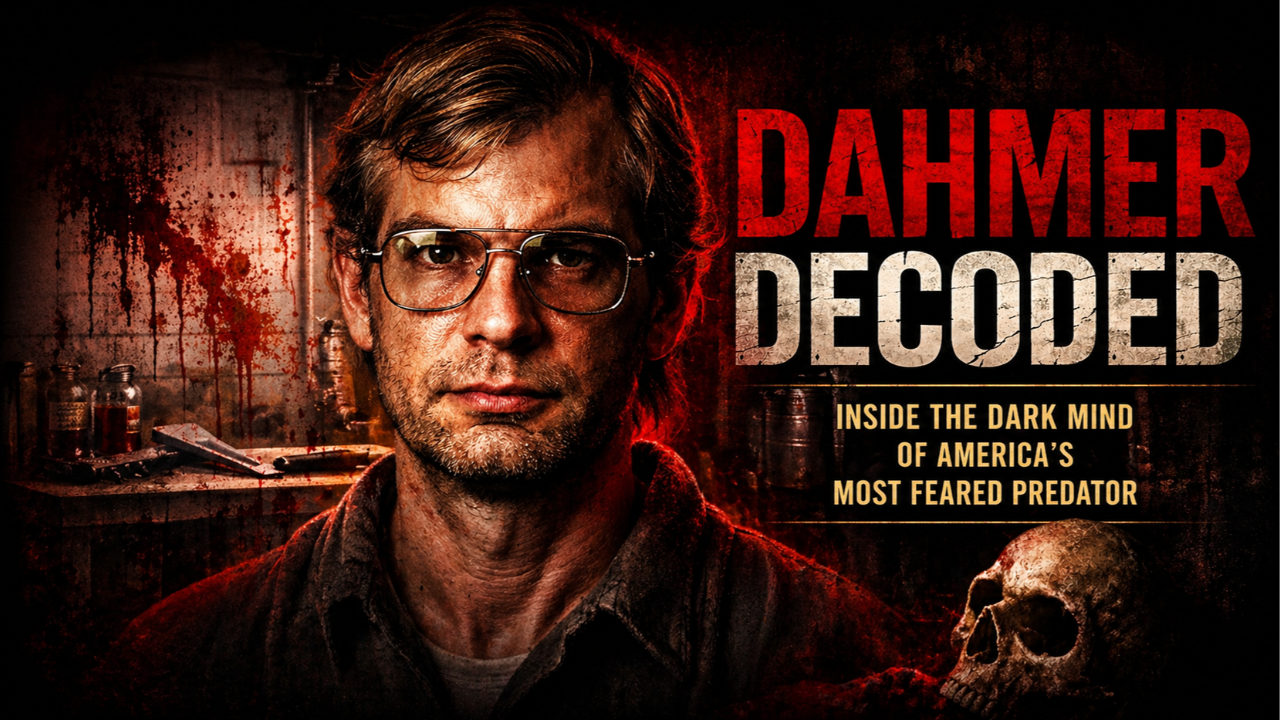
Dahmer Decoded: Inside the Dark Mind of America’s Most Feared Predator
Apr 26, 2026The Quiet Boy Next Door Who Kept Heads in His Fridge
 Most true crime books leave you with the same hollow feeling. You finish the final page, close the cover, and you still cannot answer the only question that mattered when you picked the thing up in the first place. Why. Why him. Why them. Why on earth did nobody see it coming. You get a parade of dates, a recital of victims, a courtroom transcript dressed up as drama, and then the author tips their hat and walks off stage, leaving you exactly where you started. Curious. Unsettled. Cheated.
That is the itch this book was built to scratch.
Jeffrey Dahmer is one of the most studied predators in modern history, yet he remains one of the least understood. You know the broad strokes already. The Milwaukee apartment. The acid-filled drums. The body parts in the freezer. The Polaroids the police could barely look at without retching. You have probably seen the Netflix dramatisation, the documentaries, the talking-head specials where forensic experts squint at a photograph and pronounce him a textbook this or a clinical that. None of that gets you any closer to the man. None of it answers the question you really want answered, which is how a quiet, awkward, painfully polite boy from the suburbs of Ohio ends up sat opposite a detective in 1991 calmly explaining how he tried to turn living human beings into compliant zombies by drilling holes in their skulls.
That is not a question you can answer with timelines.
Dahmer Decoded takes a different route entirely. It is built on a simple, slightly uncomfortable premise. If you want to understand a monster, you must climb inside the mind that built him. Not skim across the surface. Not gawp from a safe distance. You must sit in the dark with him, in that fetid apartment on North 25th Street, and work out what was actually going on behind those flat blue eyes while his neighbours complained about the smell and his colleagues at the chocolate factory wondered why he always looked so tired on a Monday.
Human Case Study
This book treats Jeffrey as a case study in human behaviour, not as a freak show. There is a difference, and the difference matters if you want to walk away with anything more than a queasy stomach. Every page is anchored in the psychological frameworks that forensic profilers, criminologists and behavioural analysts have spent decades refining. The Dark Triad. The MacDonald Triad. Affective immaturity. Sexual sadism conditioning. Externalised blame. The reward-pathway hijack that turns a fantasy into a compulsion and a compulsion into a body count. You do not need a degree in psychology to follow it. The whole thing is written for a curious mind over a pint, not a peer-reviewed journal.
The Dark Triad
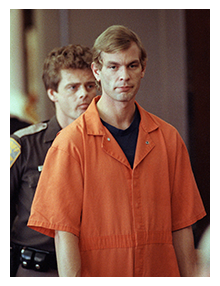 The cheeky thing about Dahmer is that on paper he should never have got away with it for as long as he did. He was not a criminal mastermind. He was sloppy. He was caught half-naked, drunk, with a bleeding fourteen-year-old boy stumbling around in the street, and the police actually walked the lad back to him, accepted his story about a lover's tiff, and left. That boy was dead within the hour. So, the obvious question is the one nobody quite manages to answer.
How. How did this lonely, alcoholic factory worker fool everyone, every single time, for thirteen years. How did his own father miss it. How did his probation officer miss it. How did the policemen who literally stood inside his apartment and smelled what they smelled walk back out again without lifting a single floorboard.
Second Skin
You already suspect part of the answer. He was white. He was polite. He was unremarkable. The boy he killed that night was Laotian, and the women who tried to flag the police down were Black, and Milwaukee in 1991 was not the city you wanted to be either of those things if you needed a copper to take you seriously. That ugly truth is in here. It must be. But it is only one strand of the rope.
The deeper strand, the one most other Dahmer books refuse to touch, is the psychological camouflage Jeffrey wore like a second skin. Superficial charm. Practised passivity. The studied art of appearing harmless. He had been training for that performance since he was a child, and by the time the world caught up with him, he had been rehearsing the role for three decades.
Discover The Dark Truth
This is where the book earns its keep. You will discover what was happening in that house in Bath, Ohio, when a small, gentle boy started bringing home roadkill and asking what was inside. You will understand why a six-year-old hernia operation may have rewired something fundamental in him. You will see the precise moment, at age fourteen, when violent fantasy first got tangled up with sexual arousal in his developing brain, and you will follow the slow, awful escalation from voyeurism to hitchhikers to homicide.
You will learn why he drank himself stupid before every single murder, and what that tells us about the quiet civil war he was fighting between his conscience and his compulsion. You will sit with him in the cells in 1992, listening to the prison chaplain, and you will form your own view about whether the conversion was sincere or just one last performance from a man who had been performing his entire life.
Understanding The Broken Mind
You will also walk away with something you did not expect. A working understanding of how predators of every stripe operate in the real world. The grooming tactics. The reading of vulnerability. The patient construction of a public mask. The strategic use of charm, alcohol, isolation. Read this book and you will never again look at a "harmless" oddball at the edge of a friend group quite the same way. That is not paranoia. That is the same pattern recognition every detective, every behavioural analyst, every hostage negotiator quietly relies on when they walk into a room.
A Warning
A small warning before you click the buy button. This book pulls no punches. The crimes were horrific, and softening them would be a disservice to the seventeen young men who died, and to your intelligence as a reader. The chapters that deal with what happened inside Apartment 213 are written with the unflinching honesty that the subject demands. If you are squeamish, you will be tested. If you are after a sanitised primer, there are gentler titles on the shelf. Dahmer Decoded is for the reader who wants the truth with the lights on, not a fairy tale told in a whisper.
Dahmer Audiobook
 The audiobook deserves its own mention, because in a story this dark, the voice in your ear matters. Listening to the chapter on the Bath, Ohio childhood while you walk the dog in the morning is a different experience to reading it on a Kindle at midnight. Both are powerful. The audio version was produced with that intimacy in mind, the campfire-story rhythm that turns a long drive or a Sunday in the garden into something quietly unforgettable. If you commute, if you run, if you cook with one earbud in, the audiobook will live with you for a week after you finish it. Possibly longer. Some of the imagery does not leave quickly.
Jeffrey Dahmer The Psychology
You may be wondering whether the world really needs another Dahmer book. The honest answer is no, it does not need another biography. There are dozens of those, and most of them recycle the same Wikipedia entries with a fresh cover. What the world has been missing is a proper psychological excavation, written for the everyday curious reader, that takes you under the floorboards of his mind rather than just listing what was found under his floorboards. That gap is the gap this book was written to fill.
This Will Scare You
Pick it up if you have ever stood in a queue behind somebody and felt a flicker of unease you could not explain. Pick it up if you watched the documentaries and were left frustrated by how shallow the analysis felt. Pick it up if you work with people, lead people, raise people, or simply share a planet with people, and you would like a sharper instinct for the difference between odd and dangerous. Pick it up because the most useful books about evil are not the ones that scare you. They are the ones that teach you to see.
The boy next door is not always the boy next door. Some of them keep heads in the fridge. The least we can do, as a species that keeps producing them, is take the time to understand how they get there.
Available from Amazon as an Audiobook, Kindle, Paperback and Hardback.

 About the author: Craig Beck is the world's foremost expert on persuasion and human behaviour. A certified NLP Master Practitioner, former broadcaster, and bestselling author of over one hundred books, he has spent two decades reverse engineering why people say yes. More than a million readers across the globe have used his work to understand the hidden mechanics of influence, decision making, and motivation. He doesn't teach theory. He shows you how the wiring of humanity works.