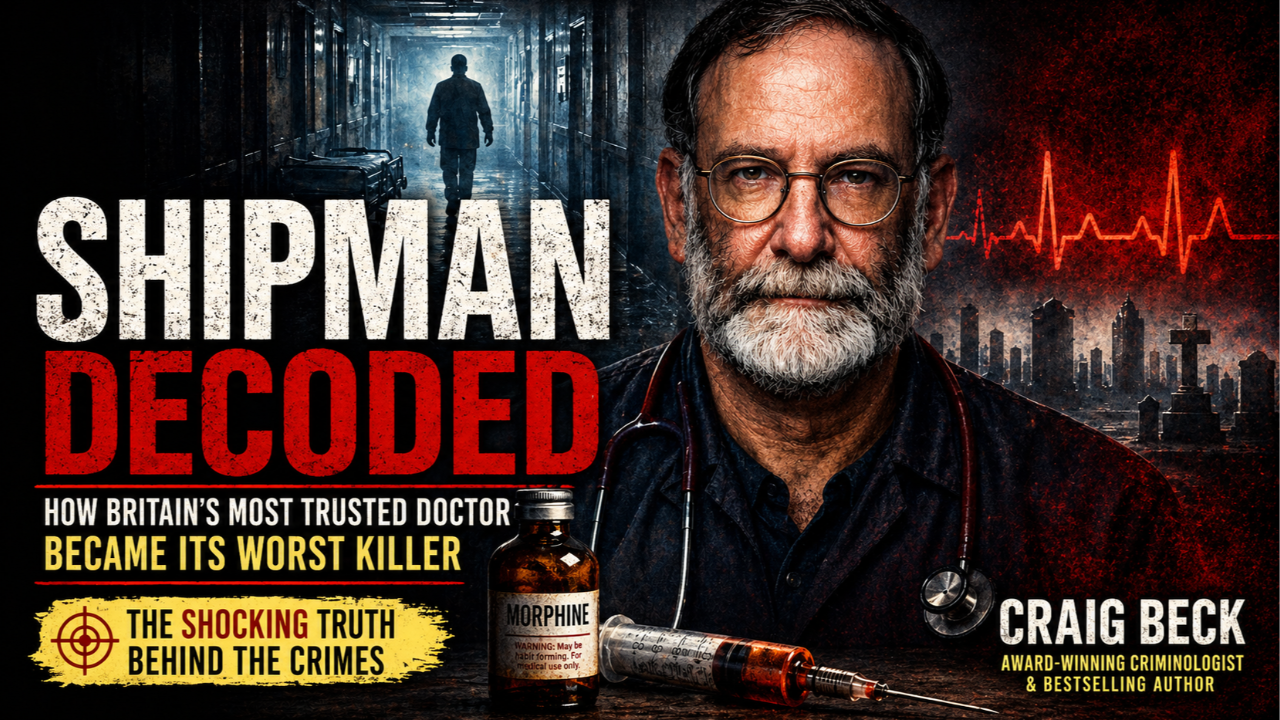
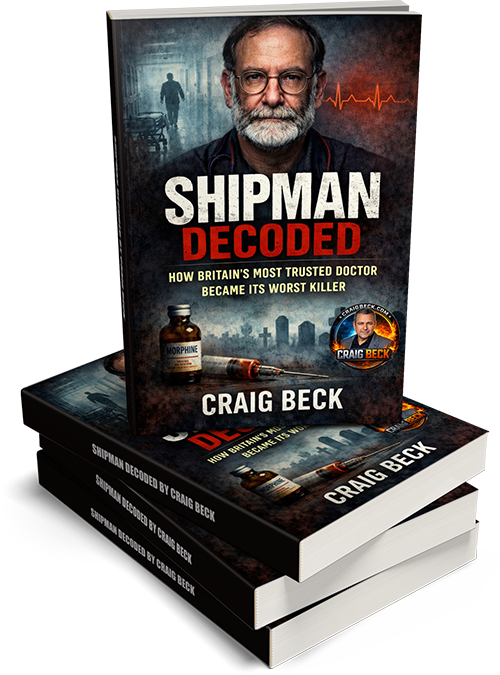
Shipman Decoded: How Britain's Most Trusted Doctor Became Its Worst Killer
Apr 27, 2026Harold Shipman Decoded: The Doctor Who Played God in Plain Sight
 The most prolific serial killer in modern history did not stalk women in alleys, did not take trophies, did not even leave a body anyone wanted to question. He arrived at your front door carrying a black leather bag and a kind smile. He sat on the edge of your mother's bed, asked how she had been sleeping, listened to her chest, and slipped a needle into the back of her hand. By the time the kettle had boiled in the kitchen, she was gone. He told you it was peaceful. He told you it was her time. You thanked him. You probably cried in front of him. And then, in some cases, you posted him a Christmas card the following year.
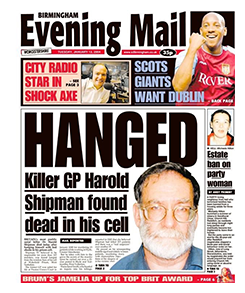
Harold Frederick Shipman, the family doctor from Hyde, Greater Manchester, is believed to have murdered at least 215 of his own patients between 1975 and 1998, with the official inquiry suspecting the real figure to be over 250. He was convicted of fifteen murders in January 2000 and hanged himself in his cell at Wakefield Prison four years later, the day before his fifty-eighth birthday, without ever offering a single word of explanation.
The horror of the Shipman case is not the body count. The horror is the method, the silence, and the truth that nobody wants to print on the front page. He was not a monster who slipped through the system. He was a monster the system was specifically designed to protect.
Want the full psychological dismantling? Get Shipman Decoded on Amazon.
Who Was Harold Shipman
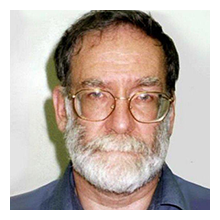
On paper, you could not have invented a more reassuring man. Stocky, bearded, bespectacled, soft spoken, the kind of GP every elderly patient in the north of England prayed they would be assigned. He listened. He made house calls when other doctors had stopped. He carried sherbet lemons in his coat pocket for nervous children. He remembered birthdays and grandchildren's names. The waiting room at his Hyde surgery had a list of patients hoping to transfer in, not out.
Born on 14 January 1946 in Nottingham, Shipman grew up on a council estate in the Edwards Lane area. His father was a lorry driver. His mother, Vera, doted on him with an intensity that would later prove fatal to several hundred people, picking him out as the bright one, the one who would rise above the family's circumstances. She drilled into him a sense of intellectual superiority that hardened over time into something far less benign. Other children, in his mother's view, were beneath him. Shipman believed her. He carried that quiet contempt into every room he ever walked into for the rest of his life.
He studied medicine at the University of Leeds, qualified in 1970, married Primrose Oxtoby in 1966 while still a student, and began his career as a junior doctor in Pontefract. By every external measure he was on track to be exactly the man his mother had imagined. But something had already broken in him. The crack had been forming since he was seventeen years old, and the world would not see it open for another two decades.
The Childhood That Built a Killer in a White Coat
 In 1963, Vera Shipman was diagnosed with terminal lung cancer. The seventeen-year-old Harold, by then already academically obsessive and emotionally guarded, became her unofficial nurse.
He sat with her every afternoon after school. He held her hand. He watched her die in instalments. And every few hours, the family doctor would arrive, open his black leather bag, and inject her with diamorphine. The pain would lift. Her breathing would soften. She would smile at her son, and slip into something that looked, to a teenage boy, suspiciously like peace.
That image is the genesis of every patient Harold Shipman ever murdered. Not the syringe. The look on her face afterwards. The teenager learnt, at the worst possible moment in his development, that a doctor with a needle could end suffering, could grant calm, and could be thanked for it. Power and tenderness fused in his head into a single act, and the act was administered by the only kind of man worth becoming.
His mother died in June of that year. Shipman went out for a long run in the rain, came home, said almost nothing, and never spoke about her again. That silence is psychologically louder than any scream. Affective immaturity, a known marker in violent offenders, shows up exactly here. The grief had nowhere to go, so it calcified. By the time he qualified as a doctor seven years later, he was carrying around a buried template of death as something administered, controlled, and witnessed by him personally. He just needed the white coat to make it permissible.
The Dark Triad in a Doctor's Uniform
Most serial killers wear their pathology on the outside eventually. They get sloppy. They taunt police. They carve symbols into bodies. Shipman did none of that, because his pathology lived inside the most powerful camouflage on Earth, the medical profession, and he had no intention of giving it up.
Look at him through the lens of the Dark Triad and the picture sharpens. The narcissism was vintage Shipman, the man who corrected his own consultants, who treated patients like inconvenient interruptions, who once told a colleague that nurses were beneath him intellectually and should know it. The psychopathy showed itself in the absence of remorse, the flat affect at funerals he had personally caused, and the famous moment after his arrest when he sat in the police interview, arms folded, and treated detectives as though they were the ones being unreasonable. The Machiavellianism was the bit that kept him hidden for twenty-three years. He chose victims nobody would question. He picked methods nobody would test for. He kept records he could later forge.
Shipman's profile pushes beyond the standard triad into something rarer and more disturbing. Forensic psychologists have classed him as a power and control killer with strong narcissistic compensation, a man whose self-image required godhood and who arranged a career in which godhood was contractually included. Every house call was a private theatre. He chose the time of death. He decided whether the patient suffered or drifted. He signed the certificate. He recommended the cremation. He patted the daughter on the shoulder and accepted a cup of tea. And then he went home, put on a cardigan, and watched the news.
Want the full psychological dismantling? Get Shipman Decoded on Amazon.
How Shipman Hunted His Patients
 The word hunt feels wrong for a man in a tweed jacket, and that is exactly the problem. He did hunt, just from a chair. His victim profile was almost surgically consistent. Elderly. Female. Living alone or with a frail spouse. Trusting. Often previously well. Frequently the kind of woman who had been a teacher, a nurse, a churchgoer, a backbone of the community. The sort of patient nobody would think to autopsy because she was, you know, just old.
He would arrive for a routine appointment, often unscheduled. He would chat. He would examine. And then, with a manner that radiated certainty, he would inject diamorphine into a vein, usually in the back of the hand or the inside of the elbow. Death came in minutes. He would either stage the body in a chair, sometimes with the television still playing, or wait, sometimes for hours, for a relative to arrive home.
To the family, the scene looked like the gentlest possible ending. To Shipman, it was a small, perfect performance with himself as both author and audience.
He covered his tracks with the casual confidence of a man who knows the rules of the game better than the people enforcing them. He recorded false symptoms in patient notes weeks before he killed them, building a paper trail of declining health that explained the eventual death. He pressed grieving families towards cremation, removing any chance of later toxicology. He routinely asked for, and frequently received, the role of certifying doctor for his own victims. By the time anyone thought to add up the numbers, the bodies were already ash.
This is the chilling part nobody likes to print. Other doctors did notice. A local undertaker named Alan Massey raised concerns about the abnormal volume of Shipman's death certificates and the eerie consistency of the death scenes, all elderly women, all sat upright, all fully clothed. A neighbouring GP, Dr Linda Reynolds, escalated the same concern to the local coroner in March 1998. The system looked at her, looked at Shipman with his beard and his bedside manner, and decided to do nothing. He killed at least three more people after that report was filed. You can read the BBC's full account of how the warnings were ignored.
The Will That Brought Down a Trusted Doctor
The deception of Kathleen Grundy is the moment the wiring of Shipman's narcissism finally short-circuited. She was eighty-one, fit, sharp, a former mayoress of Hyde, an active woman who walked into his surgery on her own two legs and was found dead in her armchair the same afternoon, with Shipman the last person to see her alive.
 He could have stopped there. Twenty-three years of practice had taught him that an elderly woman dying after a GP visit raised no eyebrows. But Shipman had been quietly sliding from compulsion into entitlement. He produced a will, supposedly typed by Mrs Grundy on a battered old typewriter, leaving her entire estate of around £386,000 to him personally. He had badly forged her signature. He had used his own surgery's machine. He had made the kind of error a junior solicitor would spot in five minutes.
Kathleen Grundy's daughter, Angela Woodruff, happened to be a solicitor. She read the will, knew immediately that her mother had not written it, and went to the police. Mrs Grundy's body was exhumed in August 1998. Toxicology found a lethal level of diamorphine. The dam burst.
Twelve more bodies were exhumed. All but one tested positive. Police seized Shipman's home computer and discovered he had retroactively altered patient records to fabricate the symptoms that justified each death. The trial began at Preston Crown Court in October 1999. On 31 January 2000 he was convicted of fifteen murders and one count of forgery, and sentenced to fifteen concurrent life terms. The judge described his crimes as so wicked that he should never be released.
He never confessed. He never apologised. He never even acknowledged the victims by name. He hanged himself in his cell at Wakefield Prison on 13 January 2004, the day before his fifty-eighth birthday, leaving Primrose with the maximum widow's pension and the country with no answers. That final act was the most Shipman thing he ever did. A last, controlled exit, on his terms, with the door slammed in everyone else's face.
What Shipman's Story Teaches Us About Spotting Predators
 Most public guidance on dangerous people focuses on the obvious. Trust your instincts about a stranger in the car park. Watch for love bombing. Notice cruelty to animals. All of that is fine, and all of that is useless against a man like Shipman, because his entire pathology was tuned to bypass instinct.
The lesson buried in this case is harder. Predators rarely look like predators. They look like the people you have been taught to defer to. The headmaster, the priest, the broadcaster, the family GP, the kindly uncle who babysits for free. Authority is the most efficient camouflage in nature, because it switches off the part of your brain that asks questions. Shipman knew that, in the way a shark knows a reef.
The same blind spot let another national treasure operate for half a century, and you can read about that pattern in the breakdown of how Britain mistook Jimmy Savile for a hero. You see it again, with different choreography, in the case of Ted Bundy and the weaponising of charm, and in the suburban respectability that hid Fred and Rose West.
The practical takeaway is small but it matters. Authority should buy a person a hearing, never an exemption. If something feels wrong about a doctor, a teacher, a trusted figure in your life or your parents' life, ask the inconvenient question. Get the second opinion. Push for the autopsy. Be the awkward family member at the funeral. Statistically, you will be wrong almost every time. But the one time you are right, you will save a life that nobody else was paying attention to.
The Question Nobody Asks About Harold Shipman
Why did he do it. That is the question every documentary asks and every documentary ducks. Most settle for the lazy answer, that he enjoyed killing, that he was simply evil. Evil is a useful word for tabloids and a useless one for psychology.
Strip the case back and the answer that fits the evidence is uncomfortable. Shipman did not kill for thrill. There is no evidence of sexual sadism, no trophies, no gloating. He did not kill for money, until the very end, and even then the money seems to have been almost an afterthought. He killed because, somewhere between his mother's bedroom in 1963 and his first NHS post in 1970, he learnt that the only moment he ever felt fully himself was the moment he held another human life in his hand and decided what to do with it.
The black bag became a portable throne. Each injection was a private coronation. He did not need to be loved, or feared, or even understood. He needed to be the one who decided. And general practice, with its locked rooms, its trusting patients, and its rubber-stamped death certificates, was the only stage in the modern world where that hunger could be fed three or four times a week without anyone noticing.
That is the part of the Shipman story that should keep you awake. Not the body count. Not the grim arithmetic of the will. The fact that one quiet, unremarkable man, properly trained and properly dressed, was able to walk into ordinary front rooms across a small Manchester town for nearly a quarter of a century and quietly play God, while neighbours waved at him from across the street and the system that should have caught him kept handing him fresh patients.
Want the full psychological dismantling? Get Shipman Decoded on Amazon.

Frequently Asked Questions
How many people did Harold Shipman kill?
He was convicted of fifteen murders in January 2000, but the official Shipman Inquiry, led by Dame Janet Smith, concluded that he was almost certainly responsible for at least 215 patient deaths between 1975 and 1998, with another 45 cases listed as highly suspicious. That makes him the most prolific known serial killer in modern British history, and arguably anywhere in the world.
What method did Harold Shipman use to murder his patients?
He almost exclusively used lethal injections of diamorphine, the medical form of heroin, administered during routine home visits or surgery appointments. His victims were overwhelmingly elderly women living alone, chosen because their deaths were unlikely to be questioned. He then forged medical records and pushed grieving families towards cremation to destroy any evidence of the morphine in the body.
Why did Harold Shipman never confess to his crimes?
Refusing to confess was psychologically consistent with everything else about him. Shipman was driven by a compulsive need for control, and admitting guilt would have meant handing that control to police, prosecutors, and victims' families. Silence was the last lever of power he still owned. He took it with him when he hanged himself in Wakefield Prison on 13 January 2004.
About The Author
 Craig Beck is the world's foremost expert on persuasion and human behaviour. A certified NLP Master Practitioner, former broadcaster, and bestselling author of over one hundred books, he has spent two decades reverse engineering why people say yes. More than a million readers across the globe have used his work to understand the hidden mechanics of influence, decision making, and motivation. He doesn't teach theory. He shows you how the wiring of humanity works.