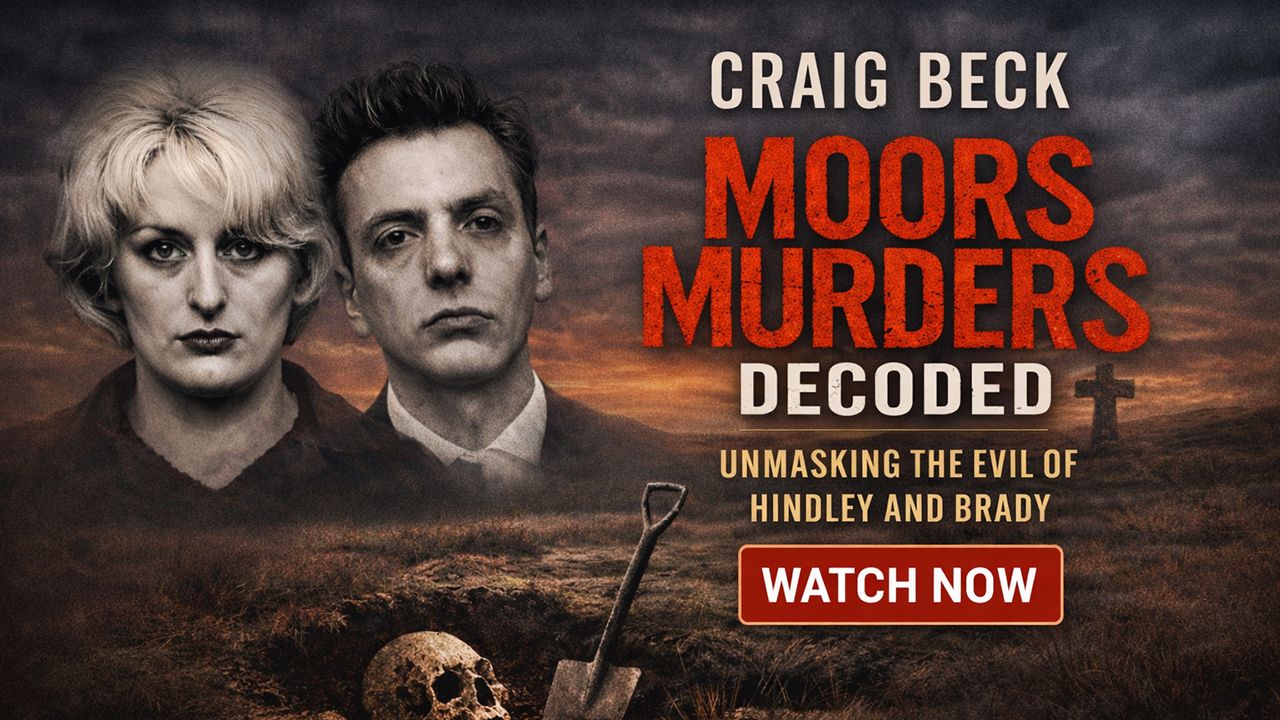
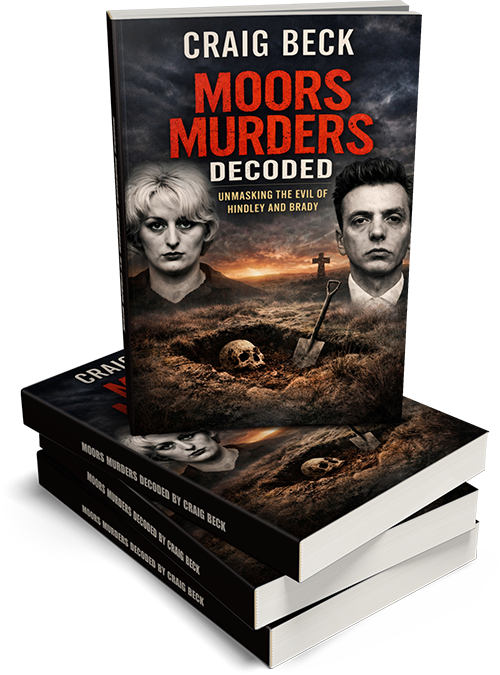
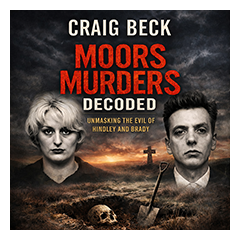
Moors Murders Decoded: Unmasking the Evil of Hindley and Brady
May 18, 2026Moors Murders Decoded: Inside the Mind of Brady and Hindley
 The Moors Murders were five child killings carried out by Ian Brady and Myra Hindley between July 1963 and October 1965 across Greater Manchester. Their victims, aged 10 to 17, were sexually abused, murdered, and buried on the peat of Saddleworth Moor. Brady, a sadistic narcissist obsessed with Nazi ideology and the writings of the Marquis de Sade, drew Hindley into his orbit and turned a convent-educated typist into the most hated woman in British criminal history.
There is a kind of evil that does not lurk in dark alleys or wear a mask. It wears a beehive hairdo, a clean blouse, and pale lipstick. It drives a battered Mini Traveller across the Pennines on a Sunday afternoon with a child in the back and a spade in the boot. That is the image of Myra Hindley that England has never managed to scrub from its memory. Pair her with a thin, sallow Glaswegian who fancied himself a Nietzschean superman, and you have the most poisonous double act this country has ever produced. Five children. Two killers. One stretch of moorland that still refuses to give up its last secret.
You think you know this story. I promise you, you do not.
Most accounts give you the bones; the dates, the names, the burial sites. Almost none of them give you the real engine, the psychological wiring that allowed two ordinary working-class people from Manchester to descend, in less than three years, into something the British public still cannot bring itself to look at directly.
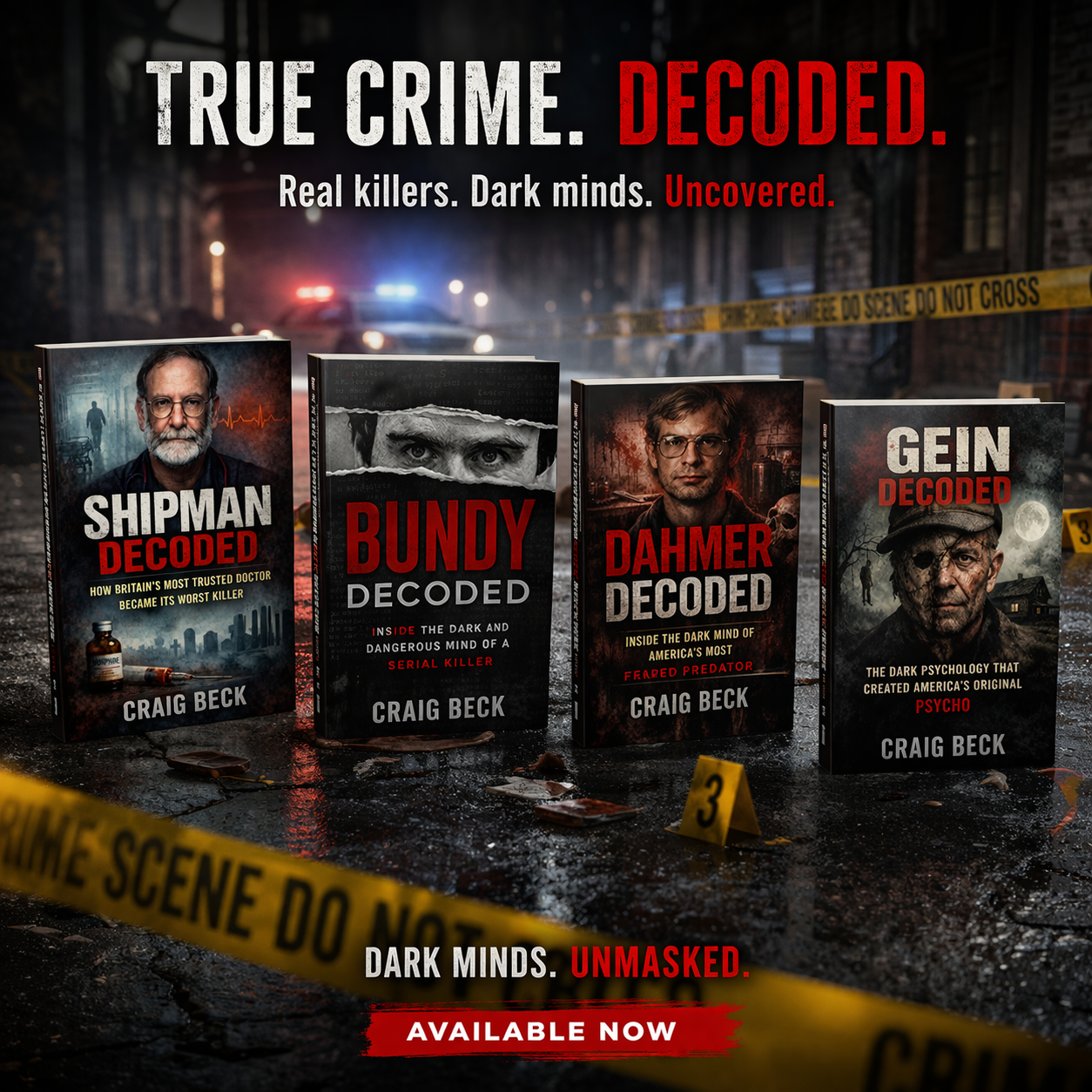
Want the full psychological dismantling? Get Moors Murders Decoded: Unmasking the Evil of Hindley and Brady on Amazon.
Who Were Ian Brady and Myra Hindley
Ian Brady was born Ian Stewart on 2 January 1938 in the Gorbals, a slum district of Glasgow that even other slums looked down on. His mother, Margaret Stewart, was a single waitress who could not raise him. Within months he was handed to John and Mary Sloan, a working-class couple who took him in informally, fed him, and gave him a reasonable approximation of family life. He was clever, withdrawn, and from an early age, cold. His foster siblings remembered cruelty to cats, bursts of rage, and a strange theatrical pleasure in hurting smaller children.
By 17 he had a string of housebreaking convictions and was sent to live with his biological mother in Manchester, who had married an Irishman called Patrick Brady. Ian took his stepfather's name. The boy who became one of Britain's most infamous killers was therefore not even using the name he was born with.
Myra Hindley was born on 23 July 1942 in Crumpsall, Manchester, into a different kind of hardship. Catholic, raised partly by her grandmother, she sang in the church choir, took her communion seriously, and was remembered as a confident, capable girl with a softness for children. Friends used her as a babysitter. Local mothers trusted her instinctively.
By 18 she had left school, learned shorthand, and walked into a job at Millwards Merchandise, a small chemical firm in Gorton. There she met the new stock clerk, a quiet Scotsman who read German philosophy at his desk and barely spoke. She fell. Not gradually. Hard.
For the next year she filled diary pages with longing entries about him while he ignored her completely. When he finally took her out, in December 1961, it was to see a film called The Trials of Oscar Wilde. She wrote afterwards that she felt she had met her destiny. She had. It was the worst thing that ever happened to her, and to the five children he would persuade her to help him kill.
The Childhood That Built a Predator
 You cannot make sense of Ian Brady without going back to that Glasgow tenement. Illegitimacy in 1938 was not a private matter. It was a brand. Brady was a "Margaret Stewart's bastard" before he could understand what those words meant. The rejection wired itself into his nervous system early. Add the absence of a father, the unspoken shame of being passed to neighbours rather than kept by blood, and you start to see the foundation slab of a personality built on contempt. Contempt for his mother. Contempt for the women in his foster family. Contempt, eventually, for the entire world that had treated him as surplus.
Childhood for Brady contained almost every textbook warning sign that forensic psychology now flags. Cruelty to animals. A fascination with fire. A pattern of secrecy, fantasy, and theatrical violence in his play. Compulsive lying, social isolation, and an early reading list that no normal teenager should be drawn to. He was working through Nietzsche, Mein Kampf, and Dostoyevsky's Crime and Punishment before he could legally drink. He did not absorb these works as literature. He absorbed them as instruction manuals.
Nietzsche told him morality was a chain forged by the weak to bind the strong. Brady took that personally. By his late teens he had built an internal philosophy in which other people were either useful tools or worthless cattle, and he was the rare specimen entitled to do as he pleased with both.
Hindley's childhood lacked Brady's overt damage, and that is what makes her case more disturbing. Her father was a violent drunk who used his fists on her mother. She lost a beloved 13-year-old friend, Michael Higgins, in a drowning accident in 1957, an event she said robbed her of her faith. By the time she met Brady, she was, in psychological terms, a perfectly grown bowl waiting to be filled. Insecure about her intelligence, hungry for a man who seemed superior, primed for a bigger story than typing letters in a chemical company. He offered her one. She paid for the privilege with everything she would ever be.
The Dark Triad in Plain Sight
The Dark Triad is the cluster that crime psychologists keep finding at the centre of organised, premeditated violence. Three traits, each on its own a personality flaw, together a chemical weapon. Psychopathy strips empathy and remorse. Narcissism inflates the sense of self into something monstrous. Machiavellianism adds the cold strategic mind that plans, manipulates, and waits. Ian Brady was a clean specimen of all three.
His psychopathy showed in a complete absence of remorse, even after half a century in prison. He never once expressed genuine sorrow for any of his victims. His narcissism showed in the way he saw himself, not as a killer but as a philosopher operating beyond ordinary morality.
He believed his crimes were a private artistic statement, evidence of his elevation above the human herd. His Machiavellianism showed in the meticulous planning, the photographs, the tape recordings, the buried evidence catalogued in a left-luggage locker at Manchester Central station. Nothing about the killings was impulsive. Everything was rehearsed.
Hindley brought a fourth element that academics often miss in folie à deux pairings. She brought normality. She brought respectability. She was the camouflage. A man asking a child to come for a walk on the moor in 1964 raised eyebrows. A young woman with the same offer raised none. Brady understood this from the start. He weaponised her ordinariness, in much the same way that other British monsters have hidden behind professional reputations. Jimmy Savile used celebrity, Harold Shipman used a stethoscope, Brady used a girlfriend with a job at the typewriter. The mask is always something the public is conditioned to trust.
How Brady and Hindley Hunted Their Victims
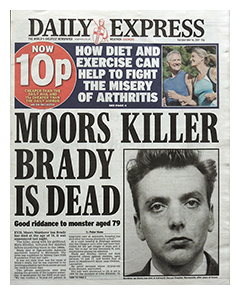 Their method was almost industrial in its repetition. They drove. They watched. They picked. The Mini Traveller would crawl through working-class streets in Manchester, Hindley behind the wheel, looking for a child alone. Brady, in the passenger seat, made the assessment. Hindley made the approach. Could the child help with a missing glove on the moor? Would they like to come and find the lost item, only a short drive away? The promise of a small task, the warmth of a friendly woman, the assumption of safety. It worked five times.
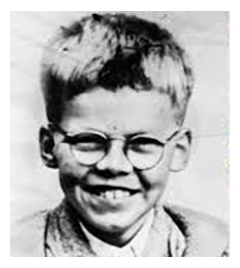
Pauline Reade was 16. She vanished on 12 July 1963 on her way to a dance, and her body was not found for another 24 years. John Kilbride was 12, lifted from Ashton-under-Lyne market on 23 November 1963. Keith Bennett was 12, taken on 16 June 1964 walking to his grandmother's house.
Lesley Ann Downey was 10, lured from a Christmas funfair in Ancoats on 26 December 1964. Edward Evans was 17, picked up at Manchester Central station on 6 October 1965. Each of them was driven to the killers' home, or to the moor, or both. Each was sexually assaulted. Each was murdered. Four were buried in shallow graves on Saddleworth Moor, the rough open land east of the city. Keith Bennett was never found, and that absence is its own quiet horror, still felt by his brother Alan and by anyone who has ever stood at the edge of that moor in the wind.
The crimes were not random. They were rituals. Brady photographed the burial sites, sometimes posing Hindley in the frame as a marker. He kept the photographs in albums. He kept a notebook of names and codes. He carried the locker key for years as a private trophy. Every detail you would expect in a clinical sexual sadist diagnosis is present, neatly catalogued, in the surviving police files held at the UK National Archives. He was not collecting evidence by accident. He was curating an archive of his own godhood.
Want the full psychological dismantling? Get Moors Murders Decoded on Amazon.
The Tape That Broke a Nation
There is a 16-minute tape recording at the centre of this case that has done more to shape British attitudes to violent crime than any single piece of evidence in the modern era. On Boxing Day 1964, Brady and Hindley took 10-year-old Lesley Ann Downey to their council house at 16 Wardle Brook Avenue in Hattersley. They forced her to pose for pornographic photographs. They gagged her. They recorded her crying for her mother, asking to go home, asking the woman in the room to help her. The woman in the room was Myra Hindley. Hindley's voice on the tape is impatient, cold, telling the child to be quiet.
The transcript, read out at the trial in Chester in 1966, broke the prosecuting counsel's voice. Jurors wept openly. The presiding judge, Mr Justice Fenton Atkinson, allowed the tape to be played in full because no other piece of evidence so completely demolished any possible defence of human decency on the part of either defendant. Hindley sat in the dock without expression. Brady looked bored. He had heard it before. Many times.
A psychologist will tell you that the tape exists for a reason that goes beyond evidence. Sexual sadists at the most severe end of the spectrum need to relive their crimes to maintain arousal. The fantasy is the engine. The act is a temporary discharge of pressure. Without the photograph, the tape, the trophy, the pressure rebuilds and the next victim becomes inevitable. Brady was not collecting souvenirs. He was building a private library to feed an appetite that could never be satisfied. Jeffrey Dahmer kept Polaroids. Ted Bundy returned to corpses. The behaviour is the same; only the choice of medium changes.
The Capture and Collapse
 The killing house at 16 Wardle Brook Avenue collapsed inwards on the night of 6 October 1965. Brady, drunk on confidence and German wine, decided to recruit a new disciple. Hindley's brother-in-law, David Smith, a 17-year-old with his own troubled history, was invited round for a drink. What he was instead invited to witness was the murder of Edward Evans with an axe.
Brady struck Evans 14 times in the head and neck. Smith later described the sound of the blade hitting bone as something he could not unhear for the rest of his life. He helped clean up under threat, fled home, vomited into the kitchen sink, and called the police from a phone box in the early hours of 7 October.
When officers arrived at the house, they found Evans's body wrapped in plastic in the upstairs bedroom. They found a notebook with John Kilbride's name in it. They found the photographs and the left-luggage ticket that led to the suitcases stuffed with planning materials. Within days they were digging on Saddleworth Moor and finding the small bones of children.
Brady and Hindley were charged. The trial ran from 19 April to 6 May 1966. Both were found guilty. Brady received three concurrent life sentences for the murders he was charged with. Hindley received two life sentences and a seven-year sentence for harbouring him. The death penalty had been abolished only weeks earlier. Many in Britain felt that timing was the cruellest joke the legal system had ever played on the public.
Brady spent the rest of his life refusing to feed himself, force-fed in Ashworth high security psychiatric hospital, dying at 79 on 15 May 2017. Hindley died of a chest infection in a Suffolk hospital on 15 November 2002, aged 60, having spent decades campaigning for parole that successive Home Secretaries refused to grant. Public opinion would not allow her release. Britain had decided. There are some sentences that polite politics simply will not overturn.
What the Moors Murders Teach Us About Spotting Predators
The grim utility of a case this old is that it holds a pattern you can recognise today. Brady was not a hooded stranger. He was a workmate who barely spoke. Hindley was not a snarling villainess. She was a babysitter the local mums trusted. The danger lived inside the most reassuring parts of an ordinary working-class community. That is the headline lesson, and it has not aged.
The deeper lesson is the pairing. When you find a dominant personality with extreme worldview obsessions, paired with a follower who has lost her own anchor, you have the conditions for shared psychotic disorder. The dominant partner outsources moral restraint by getting the follower to accept his framework. The follower outsources identity by becoming his project. Together they do things that neither would do alone. We see it in cults. We see it in extremist cells. We see it in domestic abuse cases that escalate to murder. The same dynamic plays out in Fred and Rose West, in cult killings around the world, and in countless smaller tragedies that never make the front pages.
If you spot a charismatic partner reading violent ideology with fascination rather than horror, that is a signal. If you spot a previously religious or grounded person abruptly abandoning her old life to revolve entirely around a new partner, that is a signal. If the new partner isolates her from family, friends, and faith, that is a signal. None of these alone make a killer. Together they make conditions where a killer can grow.
The Question Nobody Asks About Myra Hindley
 Was Myra Hindley a victim or a co-author of her own crimes? The lazy answer, popular for sixty years, is that Brady was the engine and Hindley the wheels. Helpful for tabloids, useless as psychology. The harder truth is that both can be true at once. Hindley was groomed in the technical sense. She was love-bombed, isolated, fed a worldview, encouraged to commit small transgressions before larger ones.
Cult researchers will recognise every step. Brady was, in his own twisted way, running her through a recruitment programme that any modern deprogrammer would identify within minutes.
But Hindley made choices. She drove the car. She lured the children. She watched the photographs being taken and the tape being made. In her later prison letters she described feeling a strange detachment, as if observing herself from outside. That is dissociation, and it is one of the brain's clearest signals that the person has chosen to keep going past a moral cliff edge rather than turn back.
Brady built the trap. Hindley walked into it.
Then she helped build the next ones, and the ones after that, and she drove the Mini Traveller home each time without crashing it into a wall.
This is why she was hated more than him. Not because she did more, but because she broke a story we like to tell ourselves. Women, especially mothers, are not supposed to do this. When one does, the public reaction is no longer horror at the crimes alone. It is horror at the rupture of an unspoken contract about who is allowed to be evil. Hindley did not only kill children. She broke a national assumption about female nature. And Britain has never quite forgiven her for it.
So, where does this leave you, the reader, sat in your kitchen with a cup of tea and a slightly heavier heart than when you started? In the same place every serious student of human darkness eventually arrives. The monsters are not creatures from the woods. They are the people you would nod to at a bus stop. The mask is the point. And the only real protection is the willingness to look closely at the things polite society would rather we did not.
Want the full psychological dismantling, the prison letters, the trial transcripts, and the answers the documentaries skip past? Get Moors Murders Decoded: Unmasking the Evil of Hindley and Brady on Amazon.

Frequently Asked Questions
How many people did Brady and Hindley kill?
Ian Brady and Myra Hindley were convicted of three murders at their 1966 trial: Lesley Ann Downey, John Kilbride, and Edward Evans. In 1987 both confessed to the additional murders of Pauline Reade and Keith Bennett, bringing the total to five children, aged between 10 and 17. Pauline Reade's body was recovered from Saddleworth Moor in July 1987. Keith Bennett's body has never been found, and Brady refused to reveal the location until his death in 2017.
Was Keith Bennett's body ever found?
No. Despite multiple police searches across decades, family-led expeditions, and repeated questioning of Brady, the body of 12-year-old Keith Bennett has never been recovered from Saddleworth Moor. Brady taunted Keith's mother Winnie Johnson with hints for years but never gave a usable location. Winnie died in 2012 without ever burying her son. His brother Alan continues to search. The unmarked grave somewhere on that moorland remains the most haunting unfinished detail in British criminal history.
Where are Brady and Hindley buried?
Myra Hindley was cremated in November 2002 after a service that 20 funeral directors reportedly refused to host before one accepted the contract. The location of her ashes has never been publicly disclosed. Ian Brady was cremated in October 2017 following a court order that prohibited his ashes from being scattered on Saddleworth Moor. His ashes were instead disposed of at sea off the Liverpool coast, in a process the coroner ordered to take place without ceremony or music. Both killers were denied any recognisable grave, a final small act of public refusal.
About the Author
 Craig Beck is the world's foremost expert on persuasion and human behaviour. A certified NLP Master Practitioner, former broadcaster, and bestselling author of over one hundred books, he has spent two decades reverse engineering why people say yes. More than a million readers across the globe have used his work to understand the hidden mechanics of influence, decision making, and motivation. He doesn't teach theory. He shows you how the wiring of humanity works.