
Ed Gein Decoded: The Dark Psychology That Created America's Original Psycho
Apr 27, 2026Ed Gein Decoded: The Mother Who Made a Monster
 Ed Gein was an American killer and grave robber from Plainfield, Wisconsin, who murdered at least two women and exhumed the corpses of nine others between 1947 and 1957. He used their skin and bones to craft masks, furniture, and a wearable woman suit. Diagnosed with schizophrenia, Gein became the psychological blueprint for Norman Bates, Leatherface, and Buffalo Bill.
We are going to crawl inside the mind of the most influential corpse-collector in modern criminal history, and the first thing you must understand is that Ed Gein never really left the farmhouse where his mother died. Not in 1945. Not in 1957 when the police found him. Not in 1984 when his body finally followed his mind into the dark. He was, in every sense that matters, a child who never grew up, trapped in the body of a fifty-one-year-old man with a fondness for skinning ladies he had dug out of the ground.
Want the full psychological dismantling? Get Gein Decoded: The Dark Psychology That Created America's Original Psycho on Amazon.
Who Was Ed Gein
Edward Theodore Gein was born on 27 August 1906 in La Crosse, Wisconsin, the second and final son of George and Augusta Gein. By the time the family moved to a 195-acre farm outside Plainfield in 1914, the rough shape of the boy was already set. His father was a weak alcoholic tanner and carpenter who could not hold work, hated himself, and was hated in turn by everyone who lived under his roof. His mother was the opposite kind of catastrophe. Augusta was a fanatical Lutheran with a voice like a sermon and a glare that could strip paint. She ran the home with the iron certainty of a woman who believed every person outside her front door was a sinner, every woman who painted her lips a whore, and every flicker of curiosity in her sons a sign that the devil was at work. Both Henry and Eddie spent their childhoods learning that the world was filthy, women were vessels of corruption, and the only safe place was the kitchen where their mother stood guard.
You can already see where this is heading. A boy raised on that diet does not grow into a balanced adult. He grows into a creature with no skin between himself and his mother, no sense of where he ends and she begins. Psychologists call it enmeshment, and you will meet that word again before we are done.
The Childhood That Built the Plainfield Butcher
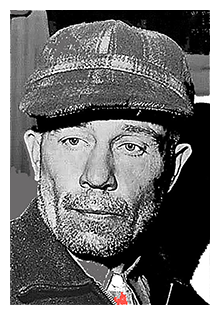 Augusta read her boys passages from the Old Testament every afternoon. The favourites were the violent bits, the plagues, the punishments, the wrath of a God who burnt cities for the sin of curiosity. She picked the verses with surgical care, the way another mother might pick a bedtime story about a friendly dragon. Eddie absorbed every word.
He never had friends his own age because Augusta forbade it. The other children at school noticed the soft, effeminate boy with the lazy eye and the nervous laugh, and they made his life small in the way children always do. He learned to retreat. The farm became a fortress. The kitchen became a chapel. Augusta became his only god.
His older brother Henry was the one human being in Eddie's life who occasionally pushed back against this airless world. Henry began to criticise their mother, suggested she might be a bit much, told Eddie that maybe she was wrong about a few things. Then in May 1944, the brothers were burning marsh grass on the family land. The fire spread. Henry was found dead. The official ruling was asphyxiation. The body had bruises on the head that the local sheriff somehow decided not to investigate.
Most modern profilers, myself included, suspect Eddie killed Henry that day, the first murder in a life that would soon become a museum of them. The motive was simple and devastating. Henry had insulted Augusta. In Eddie's universe, that was the unforgivable sin.
Eighteen months later Augusta suffered a stroke and died. Eddie was alone with the silence. He sealed her bedroom and the parlour, treating those rooms like crime scenes preserved for a return that would never come. He moved into a cramped corner of the farmhouse and let the rest of it rot. The world outside the kitchen windows softened and blurred. The world inside his head took over.
The Mother Who Wouldn't Let Him Grow Up
This is the part most true crime articles skip past, and it is the part that matters more than any of the gore that follows. Eddie Gein did not lose his mother in 1945. He lost his only point of reference. Augusta had been his god, his jailer, his moral compass, and the only voice in his head that ever told him what was real. When she died, he had no replacement. He had no friends, no lovers, no hobbies, no work he believed in, no faith of his own, no internal scaffolding of any kind. The man was hollow.
What followed was a slow, ten-year descent into a private fantasy life that grew teeth. Eddie began reading pulp magazines, anatomy books, accounts of Nazi medical experiments, and the kind of cheap horror paperbacks that filled the racks of small-town drugstores. His curiosity bent in one direction only. He wanted to know what was inside a woman. He wanted to know how she was put together. And underneath the curiosity sat a wish so dark it took him years to admit it even to himself. He wanted to become her. Specifically, he wanted to become his mother.
If you have read about another study in predatory psychology, you will recognise the pattern of a man whose desire to possess outpaces his ability to relate. Dahmer wanted lovers who would never leave. Gein wanted a mother who would never die. The route to that fantasy was the cemetery.
Why Ed Gein Doesn't Fit the Classic Killer Mould
 Pull out any standard checklist of serial killer traits and Eddie Gein only ticks half the boxes. He had the social isolation. He had the absent father and the suffocating maternal influence. He had the fascination with violence and the fantasy life rehearsed in private. But he was not a classic psychopath in the Bundy or Gacy mould. He felt something like remorse. He cried in custody.
He was, by most accounts, polite and gentle in his daily dealings with the people of Plainfield. Children liked him. Old ladies hired him as a babysitter. Yes, you read that correctly. Parents in his town paid Eddie Gein to mind their kids while they went out for the evening. He never harmed any of them.
So, what was he? The honest answer is that Eddie Gein sits in a category most people have never heard of. He was a psychotic, not a psychopath. The distinction matters. Psychopaths know exactly what they are doing and do not care. Psychotics lose their grip on reality and drift into a private world where the rules of the outside no longer apply.
Gein had elements of the same dark triad pattern you see in the more famous monsters, the social mask, the manipulation of bodies as objects, the cold strategic concealment of his crimes. But laid over the top of all that was a schizoid break with the real world that had been building since childhood. He was diagnosed with schizophrenia at trial in 1968, and the diagnosis fits.
This is why his crimes look so different from the ones you have read about a hundred times. He did not stalk. He did not plan elaborate hunts. He did not stage scenes for an audience. He took what he needed for a private project that nobody else was ever meant to see.
How Ed Gein Hunted His Victims
For most of his criminal career, Gein did not hunt the living at all. He read the obituaries. When a middle-aged woman who reminded him of his mother died and was buried in one of the three small graveyards near Plainfield, he waited for the funeral to finish, then drove out at night with a shovel. Court records and his own confession suggest he raided graves on at least nine separate occasions between 1947 and 1952, sometimes taking the whole body, sometimes only the parts he wanted. The skin of the face. The breasts. The genitals. The hair.
Back at the farmhouse he tanned the skin like leather. He was the son of a tanner, after all. He stretched the faces over wooden moulds. He sewed corsets out of female torsos so he could wear the body of a woman over his own. He kept skulls on his bedposts. He fashioned a belt of nipples. He made a lampshade from a face. He drank from a bowl that had once been the top of someone's mother's head.
Two of the bodies, at least, came not from graves but from murder. Mary Hogan, a tavern keeper, vanished from her bar in December 1954. Her face was eventually found in a sack at Gein's farm. Bernice Worden, the owner of the Plainfield hardware store, was shot in the head with a .22 rifle on the morning of 16 November 1957. She was the woman who would finally end his run. Both victims looked, in his fractured mind, like Augusta. Stout, middle-aged, sharp-tongued. He was not killing strangers. He was harvesting versions of his mother.
The Farmhouse of Horrors
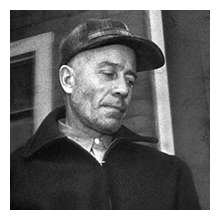 Bernice Worden's son, Frank, was the deputy sheriff of Plainfield. When his mother failed to come home from work that November Saturday, he drove to the shop, found a pool of blood and a sales slip with Eddie Gein's name on it. Eddie had been into the store earlier that morning to buy antifreeze. The receipt was the last thing he handled before he shot her.
The police arrived at the farm after dark. The kitchen was filthy, every surface coated in years of grease and refuse. The torch beam swept across the back room and caught something that did not make sense. A woman's body, hanging upside down from the rafters, dressed out like a deer carcass, headless and gutted. It was Bernice. The head was found later in a burlap sack, with twine threaded through the ears so it could be hung on a wall.
What the officers found in the rest of the house was so far beyond anything in their training that two of them were physically sick at the scene and one was reportedly never the same again. Bowls of skulls. Chairs upholstered with human skin. A shoebox containing nine vulvas, one of them painted silver and belonging, Eddie said, to his mother. A heart in a saucepan on the stove, although he later changed his story about whose heart it had been. A waistcoat made from a complete female torso, breasts and all, that he had been known to wear under the moon in the yard.
And here is the detail that gets lost in the noise. Augusta's bedroom and parlour, the rooms she had occupied in life, were spotless. Sealed. Untouched since 1945. He had let the rest of the house collapse into squalor while he kept her sanctuary perfect. The man living in that farmhouse was not really living there. He was tending a shrine.
Want the full psychological dismantling? Get Gein Decoded: The Dark Psychology That Created America's Original Psycho on Amazon.
The Capture That Shook America
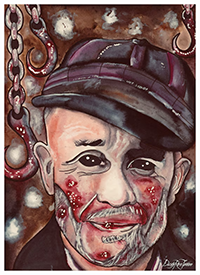 Eddie was arrested without resistance the same night. He was confused, polite, almost relieved. He confessed within hours, although his version of events shifted from telling to telling, partly because of the schizophrenia, partly because he was an unreliable narrator of his own life. The nation reacted with a kind of horror that small-town America had not seen since the days of Lizzie Borden.
The press flooded into Plainfield. The farmhouse became a tourist attraction overnight, until somebody, almost certainly a local sick of the gawkers, burnt it to the ground in March 1958. When asked about the fire, Gein, by then locked up, simply said, "Just as well."
He was found mentally unfit to stand trial in 1957 and committed to Central State Hospital for the Criminally Insane. A decade later he was retried, found guilty of the murder of Bernice Worden, then immediately found not guilty by reason of insanity. He was moved to Mendota Mental Health Institute in Madison, where he lived out the rest of his life. By every account he was a model patient. Quiet, mild-mannered, fond of reading. He died of respiratory failure on 26 July 1984 at the age of seventy-seven. His grave was vandalised so often that the headstone was eventually removed.
While Eddie was rotting away in that institution, a young writer called Robert Bloch, who had grown up only thirty-five miles from Plainfield, used Gein as the loose template for a novel published in 1959. The book was called Psycho. The film that followed in 1960 turned Eddie's mother fixation into Norman Bates and put a billion dollars of cultural baggage on top of a quiet schizophrenic from rural Wisconsin. The Texas Chain Saw Massacre borrowed his furniture. The Silence of the Lambs borrowed his woman suit. He has been dead for forty years, and you still cannot watch a horror film without his fingerprints on the screen.
What Ed Gein Teaches Us About Maternal Enmeshment
If you take only one psychological lesson from this case, take this one. The most dangerous parent is not the one who beats you. It is the one who refuses to let you become a separate person. Augusta Gein never raised a hand to her son. She did something far worse. She climbed inside his head and built a fortress in there with herself as the only inhabitant. When she died, the fortress remained, and Eddie spent the next forty years trying to repopulate it.
Modern psychology has a clean term for what Augusta did. It is called maternal enmeshment, sometimes filed under the broader heading of covert incest, although nothing physical occurred between them. The child becomes an emotional spouse. The mother's needs, opinions, fears, and prejudices become the child's entire interior life. There is no room for individuation, no room for sexuality of his own, no room for friendships, ambitions, or even the small acts of rebellion that build a normal adult identity. By the time the parent dies, the child is already a ghost.
You see softer versions of this every day. The thirty-five-year-old man who still rings his mum twice an hour. The middle-aged daughter who has never had a relationship her mother approved of, and so has never had one at all. The grown son who collapses into rage when anybody criticises the woman who raised him. Gein is the extreme version of a pattern that runs quietly through millions of homes. He is what happens when enmeshment meets schizophrenia, isolation, and a 195-acre farm with no neighbours close enough to hear the digging.
The danger sign you must learn to spot is not the obvious tyrant. It is the parent who insists, with a smile, that the child is the only person who has ever truly understood them. That is a chain dressed up as a love song.
The Question Nobody Asks About Ed Gein
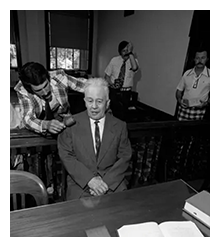 Here is what every documentary on Eddie Gein leaves on the table. Was he the killer, or was she? Augusta had been dead for twelve years by the time Bernice Worden's body was hung in the woodshed. But the consciousness that walked into the hardware store that November morning, bought antifreeze, and then took down the only person in there, was not really a man called Eddie. It was a fifty-one-year-old child still trying to be a good son. Every grave he opened, every face he stretched, every torso he sewed, every silver-painted vulva in his shoebox, was an attempt to put his mother back together. He was not building monsters. He was building her.
That is the part that should keep you up tonight. Because it suggests that the most dangerous influence in any human life is not the stranger in the alley. It is the voice in the kitchen that taught you what love looks like when you were three years old, and never let you put down the script. Most of us escape that voice with only a few scars. A handful of us, raised in the wrong farmhouse with the wrong genes and the wrong silence, never escape it at all. We just find a shovel and start digging.
Want the full psychological dismantling? Get Gein Decoded: The Dark Psychology That Created America's Original Psycho on Amazon. The book goes deeper into Augusta's letters, the trial transcripts, and the forensic reports the press never published, alongside further psychological case studies in the Decoded series.

Frequently Asked Questions
How many people did Ed Gein actually kill?
Police only ever charged Gein with the murder of Bernice Worden in 1957, and he confessed to killing tavern owner Mary Hogan in 1954. Most investigators suspect he also killed his older brother Henry in 1944. The remainder of his collection came from grave robbing, with at least nine confirmed exhumations from cemeteries near Plainfield, Wisconsin between 1947 and 1952.
Was Ed Gein a necrophile or a cannibal?
Gein denied having sex with the corpses, claiming they smelled too bad. The cannibalism question is unresolved. A human heart was found in a pan on his stove and organs were stored in his fridge, but he gave inconsistent answers under questioning. His primary obsession was wearing the bodies, especially his mother's likeness, rather than ingesting them.
What mental illness did Ed Gein suffer from?
Court psychiatrists diagnosed him with schizophrenia and a severe schizoid personality structure rooted in maternal enmeshment. He was found not guilty by reason of insanity in 1968 and spent the rest of his life in Mendota Mental Health Institute, where he died in 1984. The diagnosis aligns with the dissociation and fantasy-driven nature of his crimes.
About the author
Craig Beck is the world's foremost expert on persuasion and human behaviour. A certified NLP Master Practitioner, former broadcaster, and bestselling author of over one hundred books, he has spent two decades reverse engineering why people say yes. More than a million readers across the globe have used his work to understand the hidden mechanics of influence, decision making, and motivation. He doesn't teach theory. He shows you how the wiring of humanity works.